
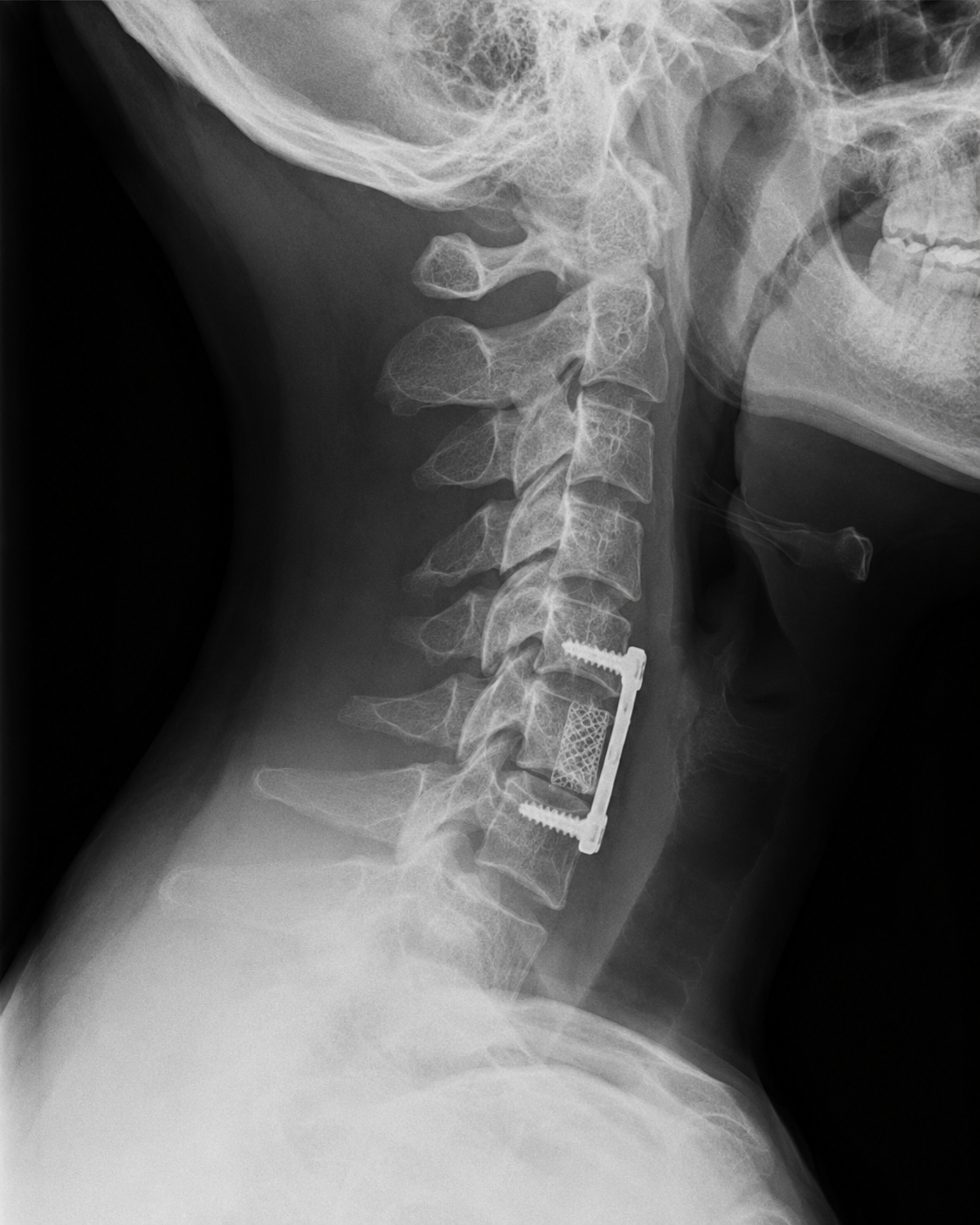
Anterior Cervical Discectomy & Fusion (ACDF) Surgery in Los Angeles
Orthopedic Spine Surgeon — Long Beach & Torrance, CA
Medically reviewed by Brandon A. Ortega, MD · Last updated July 30, 2026
Anterior cervical discectomy and fusion is a minimally invasive neck procedure that removes a damaged disc, relieves pressure on the spinal cord or nerves, and stabilizes the treated vertebrae through fusion. Many patients return to light daily activities within several weeks, while full recovery commonly takes 6 to 12 weeks. The fusion itself may continue maturing for six months or longer. Reduced arm pain, improved strength or sensation, and evidence of stable fusion on follow-up imaging are common indicators of a successful outcome.
What Is an Anterior Cervical Discectomy and Fusion?
Anterior cervical discectomy and fusion, commonly abbreviated as ACDF, is a spinal decompression and stabilization procedure performed through the front of the neck.
The procedure has three main components:
- Anterior: The cervical spine is reached through an incision at the front of the neck.
- Discectomy: The damaged or herniated disc and other tissue compressing the spinal cord or nerve roots are removed.
- Fusion: A spacer containing bone-graft material is placed in the empty disc space so the adjacent vertebrae can gradually heal together.
A plate, screws, or another fixation device may be used to maintain alignment and stability while fusion develops. The spacer also helps restore disc-space height and preserve room for the spinal nerves.
ACDF may be described as minimally invasive because the surgeon can reach the cervical spine through a relatively small incision with limited muscle dissection. However, it remains a major spinal operation requiring general anesthesia and careful postoperative recovery.
Conditions Treated
ACDF is used to treat cervical conditions that compress the spinal cord or the nerves exiting the neck, including:
- Cervical herniated discs
- Cervical radiculopathy
- Cervical spinal stenosis
- Degenerative disc disease
- Cervical spondylosis
- Bone spurs
- Cervical myelopathy
- Loss of cervical disc height
- Spinal instability
- Selected cervical fractures or traumatic injuries
- Recurrent disc herniation
- Disc-related compression at one or more cervical levels
A herniated disc or bone spur may narrow the spinal canal or the openings through which the nerves exit. This compression can cause neck pain, pain traveling into the shoulder or arm, numbness, tingling, hand or arm weakness, loss of coordination, balance problems, or difficulty walking.
ACDF is generally more predictable for symptoms caused by identifiable nerve-root or spinal-cord compression than for isolated neck pain without a clear structural cause.
Surgery Candidates and General Patient Criteria
Most patients with cervical radiculopathy or degenerative neck conditions begin with nonsurgical treatment. Depending on the diagnosis, conservative care may include:
- Activity modification
- Physical therapy
- Anti-inflammatory or pain medication
- Heat or ice
- Epidural steroid injections
- Short-term bracing in selected cases
ACDF may be considered when conservative treatment has not provided adequate relief and symptoms continue to interfere with work, sleep, mobility, or daily activities. Surgery may be recommended sooner when there is progressive weakness, worsening balance, spinal-cord compression, or another significant neurological deficit.
Potential candidates may have:
- Persistent arm pain associated with cervical nerve compression
- Numbness, tingling, or weakness in an arm or hand
- Cervical myelopathy or spinal-cord compression
- Difficulty with balance, walking, coordination, or hand dexterity
- Imaging findings that correspond with their symptoms
- One or more cervical levels requiring decompression and stabilization
- Symptoms that have not improved with appropriate conservative care
- General health suitable for anesthesia and surgery
- Adequate bone quality to support the spacer and fixation
Bone quality is important because successful ACDF depends on the vertebrae healing together. Osteoporosis, poor nutrition, nicotine use, and certain medical conditions may interfere with bone healing or increase the risk of implant loosening, subsidence, or nonunion.
Smoking and nicotine use are particularly concerning because they can delay or prevent the bone healing required for a successful spinal fusion. Patients may be asked to stop smoking before surgery and remain nicotine-free throughout recovery.
The surgical evaluation may include a physical and neurological examination, X-rays, MRI, and occasionally CT imaging or nerve testing. An abnormal scan alone does not establish the need for surgery; the imaging findings should match the patient’s symptoms and examination.
What to Expect
Before Surgery
Before ACDF, the surgical team will review the patient’s medical history, medications, allergies, previous treatments, and diagnostic imaging.
Preparation may include:
- Physical and neurological examination
- X-rays, MRI, or CT imaging
- Blood tests
- Electrocardiogram or other medical testing
- Primary-care or specialist clearance when required
- Review of prescription medications and supplements
- Evaluation of bone quality
- Instructions regarding nicotine and alcohol use
- Fasting before anesthesia
- Arranging transportation and postoperative assistance
Patients taking blood thinners, anti-inflammatory medication, supplements, or medications for diabetes may receive specific instructions. No prescribed medication should be stopped unless directed by the treating medical team.
Patients should also tell the surgeon about swallowing problems, voice changes, previous neck surgery, thyroid surgery, vascular surgery, radiation treatment, or other procedures involving the front of the neck.
During Surgery
ACDF is performed under general anesthesia. After the patient is positioned, the surgeon makes a small incision, commonly about one to two inches long, at the front or side of the neck.
The surgeon carefully develops a pathway between the muscles and other structures of the neck. The windpipe and esophagus are gently moved aside to reach the cervical spine.
The surgeon then:
- Confirms the correct spinal level using imaging.
- Removes the damaged cervical disc.
- Removes disc fragments, bone spurs, or thickened tissue pressing on the nerves or spinal cord.
- Prepares the adjacent vertebral surfaces.
- Places a spacer or cage containing bone-graft material into the disc space.
- Adds a plate, screws, or other fixation when appropriate.
- Confirms alignment and implant positioning.
- Returns the surrounding structures to their normal position and closes the incision.
The spacer may contain donor bone, the patient’s own bone, synthetic graft material, or a combination. Over time, new bone grows through and around the graft, joining the adjacent vertebrae into one stable segment.
Some patients return home on the day of surgery, while others remain overnight or longer. Discharge depends on the number of levels treated, overall health, pain control, swallowing ability, neurological function, and mobility.
Recovery and Rehabilitation
Walking is generally encouraged soon after surgery. Patients may initially experience neck soreness, throat irritation, temporary hoarseness, or difficulty swallowing because the spine was accessed through the front of the neck.
Recovery instructions may include:
- Taking short, frequent walks
- Keeping the incision clean and dry
- Taking medication as directed
- Eating softer foods temporarily if swallowing is uncomfortable
- Avoiding heavy lifting
- Limiting forceful bending or twisting of the neck
- Avoiding strenuous or high-impact activities
- Wearing a cervical collar when prescribed
- Avoiding driving until medically cleared
- Remaining nicotine-free
- Attending postoperative examinations and imaging
Many patients return to desk-based work within approximately three to six weeks, depending on their symptoms and the extent of surgery. Physical work, heavy lifting, and high-impact activities generally require a longer recovery period.
Physical therapy may begin approximately four to six weeks after surgery when recommended. Rehabilitation may focus on posture, walking, shoulder mobility, neck and upper-body strength, body mechanics, and a gradual return to work or exercise.
A functional recovery may occur within 6 to 12 weeks, but the biological fusion process takes longer. The vertebrae may require six months to a year to become solidly fused. Activity restrictions should therefore be based on clinical and imaging follow-up rather than symptoms alone.
Arm pain caused by direct nerve compression may improve relatively quickly. Numbness, weakness, balance problems, and hand-coordination difficulties may recover more gradually. Longstanding spinal-cord or nerve damage may not resolve completely even after successful decompression.
Potential Complications and Success Indicators
Potential complications of ACDF include:
- Infection
- Bleeding or postoperative hematoma
- Blood clots
- Reaction to anesthesia
- Temporary or persistent difficulty swallowing
- Throat soreness or hoarseness
- Injury to the esophagus, windpipe, blood vessels, or vocal-cord nerve
- Nerve-root or spinal-cord injury
- Dural tear and spinal-fluid leakage
- Persistent or recurrent symptoms
- New numbness or weakness
- Failure of the vertebrae to fuse
- Graft or implant settling
- Hardware loosening, movement, or breakage
- Loss of cervical alignment
- Degeneration at an adjacent spinal level
- Need for revision surgery
Difficulty swallowing is relatively common during the early recovery period and is usually temporary. Rapidly increasing neck swelling, difficulty breathing, or severe difficulty swallowing requires immediate medical attention.
Nonunion, also called pseudarthrosis, occurs when the vertebrae do not form a solid fusion. The risk may be affected by nicotine use, poor bone quality, nutrition, medical conditions, the number of levels fused, and adherence to postoperative restrictions.
Indicators of a successful outcome may include:
- Reduced pain traveling into the shoulder or arm
- Improved arm or hand strength
- Reduced numbness or tingling
- Improved balance or walking ability
- Better hand coordination
- Improved sleep and daily function
- Reduced reliance on pain medication
- Stable spinal alignment and hardware
- Progressive bone formation across the treated level
- Return to work, exercise, and normal activities
ACDF has a high likelihood of relieving appropriately selected nerve-compression symptoms, but it cannot guarantee complete pain relief or neurological recovery. Cleveland Clinic reports overall success rates of approximately 85% to 95%, though results depend on the diagnosis, symptom duration, number of levels treated, health factors, and how success is defined.
Patients should promptly contact their surgical team for fever, increasing redness or drainage, worsening weakness or numbness, severe or increasing pain, persistent vomiting, new bladder or bowel dysfunction, difficulty breathing, or rapidly worsening swallowing problems.
Anterior Cervical Discectomy & Fusion (ACDF) Surgery in Los Angeles Q&A
Is ACDF considered minimally invasive?
ACDF may be considered minimally invasive because the surgeon reaches the cervical spine through a small anterior incision and separates natural tissue planes with limited muscle disruption. However, it is still a major operation involving spinal decompression, implantation, and bone fusion.
How many spinal levels can be treated with ACDF?
ACDF may be performed at one or multiple cervical levels. The number of levels treated depends on where compression is present, spinal alignment, stability, symptoms, and overall health. Multilevel fusion may involve a longer recovery and a greater risk of nonunion or reduced neck motion.
How is ACDF different from cervical disc replacement?
Both procedures remove a damaged cervical disc and decompress the nerves or spinal cord. ACDF places graft material between the vertebrae so they fuse together, while cervical disc replacement uses a mobile implant intended to preserve motion. Disc replacement is limited to selected patients with suitable bone quality, alignment, and facet joints; ACDF may be appropriate for a broader range of degenerative or unstable conditions.
Why Choose BAO Spine?
Fellowship-trained expertise
Advanced, subspecialty training in complex and minimally invasive spine surgery.
Conservative care first
Most patients improve without surgery — treatment begins with the least invasive options.
Motion-preserving techniques
Cervical and lumbar disc replacement that protects your natural range of motion.
Two convenient locations
Personalized spine care in both Long Beach and Torrance, California.

About Dr. Ortega
Brandon A. Ortega, MD, is a fellowship-trained orthopedic spine surgeon providing comprehensive, personalized spinal care to adults in Long Beach and Torrance, California. His dedication to helping each patient regain mobility, reduce pain, and improve their quality of life has earned the respect of everyone in the community struggling with neck and back pain.
Consultation
Get expert care with anterior cervical discectomy & fusion (ACDF) surgery in Los Angeles
Request an appointment and Brandon A. Ortega, MD's team will reach out to schedule your visit — fellowship-trained, personalized spine care.
Prefer to call? Contact us.