
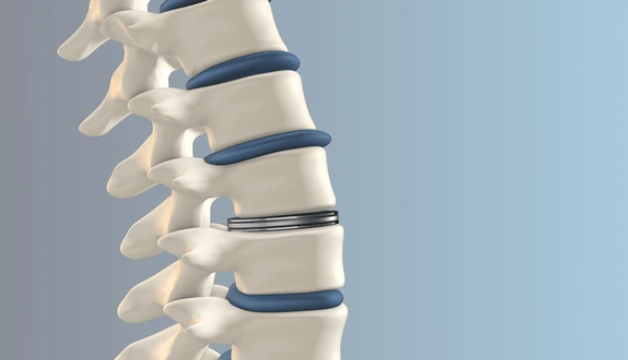
Artificial Disc Replacement Surgery in Los Angeles
Orthopedic Spine Surgeon — Long Beach & Torrance, CA
Medically reviewed by Brandon A. Ortega, MD · Last updated July 30, 2026
Artificial disc replacement removes a damaged spinal disc and replaces it with a motion-preserving implant. For carefully selected patients, the procedure may relieve nerve-related or disc-related symptoms while maintaining movement at the treated spinal level.
What Is an Artificial Disc Replacement?
Artificial disc replacement, also called total disc replacement or disc arthroplasty, is an alternative to spinal fusion for selected cervical and lumbar conditions.
During surgery, the damaged disc is removed, pressure on nearby nerves or the spinal cord is addressed, and an artificial disc is positioned between the adjacent vertebrae. The implant is designed to restore disc-space height, support the treated segment, and preserve some spinal motion. However, a full or normal range of motion is not guaranteed after surgery.
Unlike spinal fusion, which joins two vertebrae so that they no longer move independently, artificial disc replacement is intended to maintain movement at the treated level. The appropriate operation depends on the location of the damaged disc, the condition of the surrounding joints, spinal alignment, bone quality, and the patient’s symptoms.
Conditions Treated
Artificial disc replacement may be considered for selected conditions involving one or more damaged spinal discs, including:
- Cervical degenerative disc disease
- Lumbar degenerative disc disease
- Cervical disc herniation
- Cervical radiculopathy
- Cervical myelopathy caused by disc-level compression
- Symptomatic loss of disc height
- Bone-spur formation associated with a damaged cervical disc
- Disc-related lower-back pain in carefully selected patients
- Persistent symptoms that have not responded to appropriate nonsurgical treatment
The presence of disc degeneration on an MRI does not automatically make someone a candidate. The abnormal disc should correspond with the patient’s symptoms, examination findings, and other diagnostic results. FDA indications also vary by implant, spinal level, and number of discs treated.
Types of Disc Replacement Procedures
Cervical Disc Replacement
Cervical disc replacement treats a damaged disc in the neck. It is commonly performed through an incision at the front of the neck.
The surgeon carefully moves the nearby structures aside, removes the damaged disc, decompresses the affected nerve roots or spinal cord, and places the artificial disc between the adjacent cervical vertebrae.
Cervical disc replacement may be considered for symptoms such as:
- Neck and arm pain
- Numbness or tingling in an arm or hand
- Arm or hand weakness
- Cervical radiculopathy
- Spinal-cord compression associated with a damaged disc
- Reduced function caused by symptomatic cervical disc disease
Certain FDA-approved cervical implants may be used at one or two adjacent levels between C3 and C7 in skeletally mature patients who meet the device’s specific criteria.
Thoracic Disc Replacement
Thoracic disc replacement would involve replacing a damaged disc in the middle portion of the spine. This is substantially less common than cervical or lumbar disc replacement because thoracic disc disease requiring surgery is uncommon, the rib cage limits access, and the spinal cord occupies this region of the spinal canal.
In the United States, commonly used FDA-approved artificial discs are designed and labeled for specific cervical or lumbar levels. Thoracic disc replacement is therefore not a routine treatment and may involve an off-label or investigational application. This conclusion is based on the spinal levels included in current cervical and lumbar device approvals.
Patients with thoracic disc disease are more commonly evaluated for decompression, discectomy, or fusion. Any consideration of thoracic disc replacement requires highly individualized assessment of the disc, spinal cord, rib-cage anatomy, bone quality, and available implant options.
Lumbar Disc Replacement
Lumbar disc replacement treats a damaged disc in the lower back. Surgery is generally performed through an incision in the abdomen so the surgeon can approach the front of the lumbar spine without passing through the muscles and nerves at the back.
The damaged disc is removed, the disc space is prepared, and an appropriately sized implant is positioned between the vertebrae. The device is intended to maintain disc height and permit movement at the treated level.
Lumbar replacement may be considered for carefully selected patients with disc-related lower-back pain and degeneration at an approved level. Depending on the specific device, indications may be limited to one or two levels between L3 and S1 and may require unsuccessful nonsurgical treatment for at least six months.
Surgery Candidates and General Patient Criteria
Artificial disc replacement has narrower eligibility requirements than many other spinal procedures. A patient may be considered when:
- Symptoms correspond with a specific damaged disc
- Imaging confirms degeneration, herniation, loss of disc height, or related compression
- Appropriate nonsurgical treatment has not provided sufficient relief
- The patient’s bones are skeletally mature
- The treated spinal segment retains suitable motion
- Bone quality is adequate to support the implant
- There is little or no significant facet-joint arthritis
- Spinal alignment and stability are appropriate
- The number and location of damaged discs fall within the implant’s indications
- The patient is medically able to undergo surgery and anesthesia
Patients with good spinal motion and minimal arthritis are generally stronger candidates than those with extensive degeneration throughout the treated segment.
Artificial disc replacement may not be appropriate for patients with severe osteoporosis or osteopenia, active infection, major spinal instability, advanced facet-joint disease, significant deformity, certain fractures, severe stenosis, or sensitivity to implant materials. Eligibility and exclusions differ between devices, so candidacy must be assessed against the labeling for the proposed implant.
Recovery and Rehabilitation
Patients are usually encouraged to begin standing and walking soon after surgery. The length of hospitalization and overall recovery period depend on whether the procedure was cervical or lumbar, how many levels were treated, the patient’s health, and whether additional procedures were required.
Recovery instructions may include:
- Taking short, regular walks
- Keeping the incision clean and dry
- Using medication as directed
- Temporarily limiting lifting, bending, twisting, or strenuous exercise
- Avoiding driving until medically cleared
- Attending follow-up appointments and imaging
- Beginning physical therapy when recommended
- Gradually returning to work and normal activities
Physical therapy may focus on posture, flexibility, strength, movement mechanics, and a safe return to activity. Patients should avoid advancing activity too quickly because excessive loading may interfere with healing or affect the implant.
Reduced arm or leg pain may occur relatively early, while numbness or weakness can take longer to improve. Nerve recovery depends partly on the duration and severity of compression before surgery.
Potential Complications and Success Indicators
Artificial disc replacement carries the general risks of spine surgery as well as risks associated with an implanted device.
Potential complications include:
- Infection
- Bleeding or blood clots
- Reaction to anesthesia
- Nerve-root or spinal-cord injury
- Persistent or recurrent pain
- Numbness or weakness
- Implant migration, loosening, wear, or breakage
- Implant settling into the surrounding bone
- Incorrect implant positioning
- Bone formation around the implant that restricts movement
- Loss of motion or unintended fusion at the treated level
- Degeneration of nearby discs or facet joints
- Fracture of the surrounding vertebrae
- The need for revision surgery or removal of the implant
Additional risks depend on the surgical approach. Cervical surgery may cause temporary swallowing difficulty, hoarseness, or injury to structures in the neck. Lumbar surgery performed through the abdomen carries risks involving major blood vessels, abdominal structures, and reproductive function.
Signs of a successful outcome may include:
- Reduced neck, back, arm, or leg pain
- Improved strength or sensation
- Better ability to perform daily activities
- Maintenance of movement at the treated level
- Improved walking, sitting, or working tolerance
- Stable implant positioning on follow-up imaging
Artificial disc replacement does not guarantee complete pain relief or normal movement. Success depends on selecting the correct patient, identifying the true source of symptoms, placing the implant accurately, and following postoperative instructions.
Artificial Disc Replacement Surgery in Los Angeles Q&A
How is artificial disc replacement different from spinal fusion?
Both procedures remove a damaged disc. Fusion places graft material or an implant between the vertebrae so they heal together, eliminating movement at that level. Disc replacement uses a mobile implant intended to preserve movement. Disc replacement is not automatically preferable; fusion may be more appropriate when substantial arthritis, instability, deformity, or poor bone quality is present.
How long does an artificial spinal disc last?
Artificial discs are designed for long-term implantation, but no device can be guaranteed to last for a patient’s lifetime. Longevity depends on the implant, its position, the patient’s anatomy, activity level, bone quality, and changes elsewhere in the spine. Patients should continue with recommended long-term clinical and imaging follow-up.
Can more than one spinal disc be replaced?
Sometimes. Certain FDA-approved cervical and lumbar devices permit treatment at two adjacent levels, while others are approved only for a single level. Multilevel eligibility depends on the specific implant, spinal region, anatomy, and condition of the surrounding joints.
Why Choose BAO Spine?
Fellowship-trained expertise
Advanced, subspecialty training in complex and minimally invasive spine surgery.
Conservative care first
Most patients improve without surgery — treatment begins with the least invasive options.
Motion-preserving techniques
Cervical and lumbar disc replacement that protects your natural range of motion.
Two convenient locations
Personalized spine care in both Long Beach and Torrance, California.

About Dr. Ortega
Brandon A. Ortega, MD, is a fellowship-trained orthopedic spine surgeon providing comprehensive, personalized spinal care to adults in Long Beach and Torrance, California. His dedication to helping each patient regain mobility, reduce pain, and improve their quality of life has earned the respect of everyone in the community struggling with neck and back pain.
Consultation
Get expert care with artificial disc replacement surgery in Los Angeles
Request an appointment and Brandon A. Ortega, MD's team will reach out to schedule your visit — fellowship-trained, personalized spine care.
Prefer to call? Contact us.