
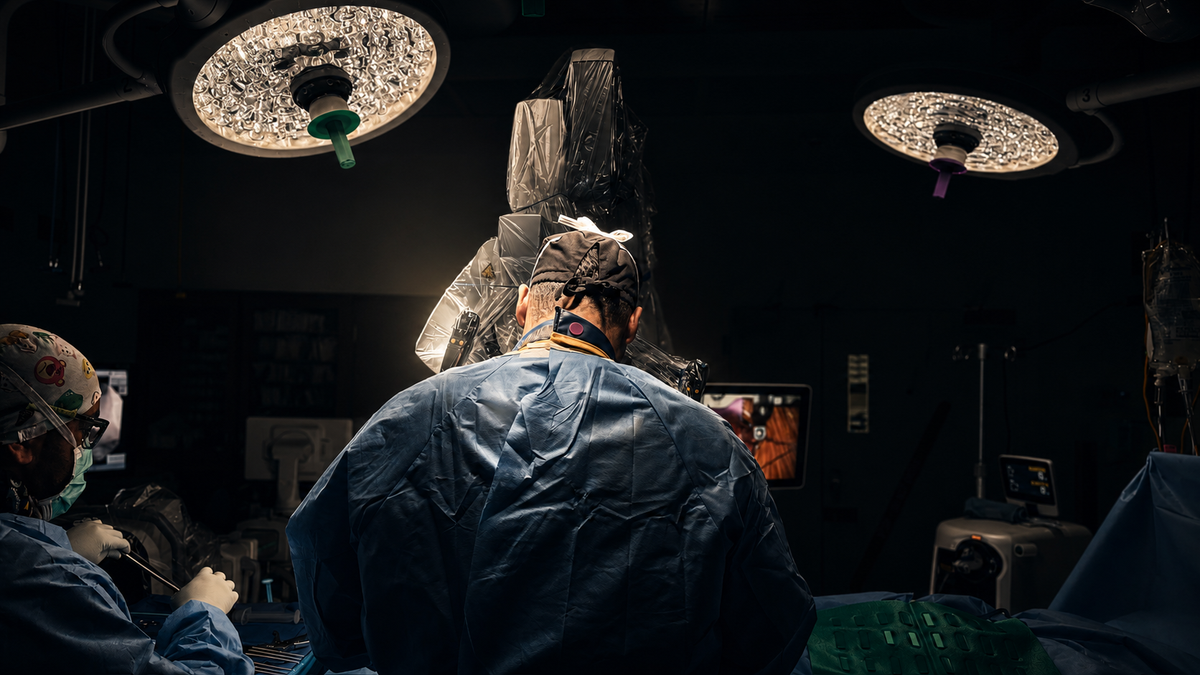
Minimally Invasive Spine Surgery in Los Angeles
Orthopedic Spine Surgeon — Long Beach & Torrance, CA
Medically reviewed by Brandon A. Ortega, MD · Last updated July 30, 2026
Minimally invasive spine surgery uses specialized instruments, imaging, and smaller access points to treat certain spinal conditions while limiting disruption to surrounding muscles and soft tissue. Depending on the diagnosis, MISS may relieve nerve compression, restore spinal stability, or correct structural problems with less tissue exposure than traditional open surgery.
How Minimally Invasive Spine Surgery (MISS) Works
Minimally invasive spine surgery, commonly abbreviated as MISS, is not one specific operation. It describes a group of surgical techniques used to reach and treat the spine through smaller incisions and muscle-sparing pathways.
During many procedures, the surgeon introduces a series of dilators that gently separate the muscle fibers. A tubular retractor then creates a narrow working channel to the affected area. Specialized instruments, a microscope, an endoscope, or a small camera may be passed through this channel.
Real-time X-ray, CT-based navigation, or robotic-assisted guidance may also be used to identify the correct spinal level and help position surgical instruments or implants. Once treatment is completed, the instruments are removed, allowing the surrounding tissues to return toward their natural position.
The exact technique depends on the affected spinal region, the condition being treated, the patient’s anatomy, and whether the goal is to decompress a nerve, remove damaged tissue, or stabilize the spine. MISS can be performed from the front, side, or back of the body.
Benefits of MISS
By limiting the amount of muscle and soft-tissue disruption required to reach the spine, minimally invasive techniques may provide several advantages over a comparable open procedure:
- Smaller surgical incisions
- Less disruption to muscles and surrounding tissue
- Reduced blood loss
- Less postoperative discomfort
- Shorter hospitalization in selected cases
- Lower risk of certain wound-related complications
- Faster return to some normal activities
- Reduced scarring
- Less extensive postoperative rehabilitation
Some MISS procedures can be performed on an outpatient basis, while others require one or more nights in the hospital.
A smaller incision does not automatically make an operation safer or more appropriate. Certain complex conditions require a wider surgical approach so that the surgeon can clearly see and safely treat the affected structures. The best approach is the one that provides adequate treatment while managing the patient’s individual risks—not necessarily the approach with the smallest incision.
Conditions Treated
Minimally invasive spine surgery may be considered for conditions affecting the cervical, thoracic, or lumbar spine, including:
- Herniated or bulging discs
- Degenerative disc disease
- Cervical or lumbar spinal stenosis
- Sciatica and lumbar radiculopathy
- Cervical radiculopathy
- Bone spurs
- Spondylolisthesis
- Spinal instability
- Compression fractures
- Certain spinal deformities
- Selected spinal tumors or infections
- Recurrent disc herniation
- Persistent nerve compression following previous treatment
Surgery is generally considered when symptoms correspond with examination and imaging findings and have not improved sufficiently with appropriate nonsurgical care. Treatment before surgery may include activity modification, medication, physical therapy, or spinal injections.
Not every patient with back pain, neck pain, or an abnormal MRI requires surgery. MISS is most useful when the surgeon can identify a specific structural problem that can be safely corrected through a limited surgical pathway.
Minimally Invasive Procedures
The term MISS includes several procedures. The appropriate operation depends on the condition, spinal level, symptoms, and amount of nerve compression or instability.
Minimally Invasive Microdiscectomy
Microdiscectomy removes the portion of a herniated disc that is pressing against a spinal nerve. The surgeon works through a small access channel while preserving as much healthy disc and surrounding tissue as possible.
This procedure is commonly used to treat sciatica or other radiating symptoms caused by a lumbar disc herniation.
Endoscopic Spine Surgery
Endoscopic surgery uses a narrow camera and specialized instruments introduced through a small incision. The camera provides a magnified view of the affected area while the surgeon removes disc material, bone, or other tissue causing nerve compression.
Not every disc herniation or spinal condition can be treated endoscopically. The location and size of the problem must allow the surgeon to safely reach it through the endoscopic pathway.
Minimally Invasive Laminotomy or Laminectomy
A laminotomy removes a small portion of the lamina, which forms part of the back of a vertebra. A laminectomy removes a larger portion when additional space is required.
These decompression procedures may be performed to treat spinal stenosis or another condition that is narrowing the spinal canal and compressing nerves.
Minimally Invasive Foraminotomy
A foraminotomy enlarges the opening through which a spinal nerve exits the spinal canal. Bone, ligament, or disc tissue may be removed to relieve pressure on the affected nerve.
Minimally Invasive Spinal Fusion
Spinal fusion permanently joins two or more vertebrae to treat instability, deformity, or painful movement. Through smaller incisions, the surgeon may remove a damaged disc, insert a spacer or bone-graft material, and place screws or rods using image guidance.
Fusion generally requires a longer recovery than a decompression-only procedure because the treated vertebrae need time to heal together.
What to Expect
Before surgery, the surgeon will review the patient’s symptoms, medical history, physical examination, and diagnostic imaging. Preoperative preparation may include blood tests, medical clearance, medication adjustments, and instructions regarding eating and drinking.
Patients should tell the surgical team about all prescription medications, over-the-counter products, supplements, allergies, bleeding conditions, and use of blood-thinning medication. Medications should not be stopped unless directed by the treating clinician.
MISS may be performed under general anesthesia or, for certain procedures, regional or local anesthesia with sedation. During surgery, the patient’s vital signs are continuously monitored.
The surgeon creates one or more small incisions and uses imaging to confirm the appropriate spinal level. Dilators, a tubular retractor, an endoscope, or other specialized instruments are then used to reach the spine. The surgeon performs the required decompression, disc removal, repair, or stabilization before closing the incision.
Some patients return home on the day of surgery. More extensive decompression or fusion procedures may require an inpatient stay. The surgical team will determine discharge timing based on the procedure, pain control, mobility, neurological status, and general health.
Recovery and Rehabilitation
Recovery varies considerably depending on the procedure performed. A patient recovering from a small decompression or discectomy may return to basic activities sooner than someone recovering from a multilevel fusion.
Patients are often encouraged to begin walking shortly after surgery. Early movement can support circulation and help restore mobility, but activity should be increased gradually.
Postoperative instructions may include:
- Keeping the incision clean and dry
- Taking medications as directed
- Walking for short periods throughout the day
- Temporarily limiting lifting, bending, and twisting
- Avoiding strenuous exercise until cleared
- Wearing a brace when prescribed
- Attending scheduled follow-up appointments
- Beginning physical therapy when appropriate
Physical therapy may focus on flexibility, posture, core strength, movement mechanics, and a safe return to work or recreational activities.
Patients with sedentary jobs may return sooner than those whose work requires lifting, climbing, prolonged driving, or repetitive movement. Recovery should be based on the specific procedure and the surgeon’s instructions rather than a universal timeline.
Potential Complications and Success Indicators
Minimally invasive techniques can reduce some forms of surgical trauma, but they do not eliminate surgical risk. Potential complications may include:
- Infection
- Bleeding
- Blood clots
- Reaction to anesthesia
- Nerve-root or spinal cord injury
- Dural tear and spinal-fluid leakage
- Persistent or recurrent symptoms
- Recurrent disc herniation
- Implant movement or hardware problems
- Failure of the bones to fuse
- Need for another operation
- Conversion to a larger or open surgical approach
Risk varies based on the patient’s age, overall health, smoking status, bone quality, diagnosis, and type of surgery. Patients considering fusion may have additional risks related to bone healing and instrumentation.
Signs of a successful outcome may include reduced radiating arm or leg pain, improved walking tolerance, increased strength, better sleep, improved function, and a gradual return to normal activities.
Some symptoms recover more slowly than others. Longstanding numbness or weakness may persist even after pressure has been removed because nerve recovery is gradual and may be incomplete.
Patients should promptly report fever, worsening wound drainage, increasing weakness or numbness, uncontrolled pain, severe headache, difficulty breathing, chest pain, or new bladder or bowel dysfunction.
Minimally Invasive Spine Surgery in Los Angeles Q&A
Is minimally invasive spine surgery appropriate for everyone?
No. MISS is appropriate only when the condition can be safely reached and adequately treated through a limited surgical pathway. Complex deformities, severe osteoporosis, multilevel disease, previous surgery, or certain medical conditions may make an open or alternative approach safer.
How long does recovery from MISS take?
Recovery depends on the procedure. Some patients undergoing a limited decompression may resume basic activities within several weeks, while recovery after spinal fusion may take several months. The patient’s health, occupation, number of levels treated, and adherence to postoperative restrictions also affect recovery.
Is minimally invasive spine surgery safer than open surgery?
MISS may reduce blood loss, muscle disruption, postoperative pain, and hospitalization for appropriately selected patients. However, it is not automatically safer in every case. When a wider view is needed to protect nerves, place hardware, or treat a complex condition, an open approach may be the safer option.
Why Choose BAO Spine?
Fellowship-trained expertise
Advanced, subspecialty training in complex and minimally invasive spine surgery.
Conservative care first
Most patients improve without surgery — treatment begins with the least invasive options.
Motion-preserving techniques
Cervical and lumbar disc replacement that protects your natural range of motion.
Two convenient locations
Personalized spine care in both Long Beach and Torrance, California.

About Dr. Ortega
Brandon A. Ortega, MD, is a fellowship-trained orthopedic spine surgeon providing comprehensive, personalized spinal care to adults in Long Beach and Torrance, California. His dedication to helping each patient regain mobility, reduce pain, and improve their quality of life has earned the respect of everyone in the community struggling with neck and back pain.
Consultation
Get expert care with minimally invasive spine surgery in Los Angeles
Request an appointment and Brandon A. Ortega, MD's team will reach out to schedule your visit — fellowship-trained, personalized spine care.
Prefer to call? Contact us.