
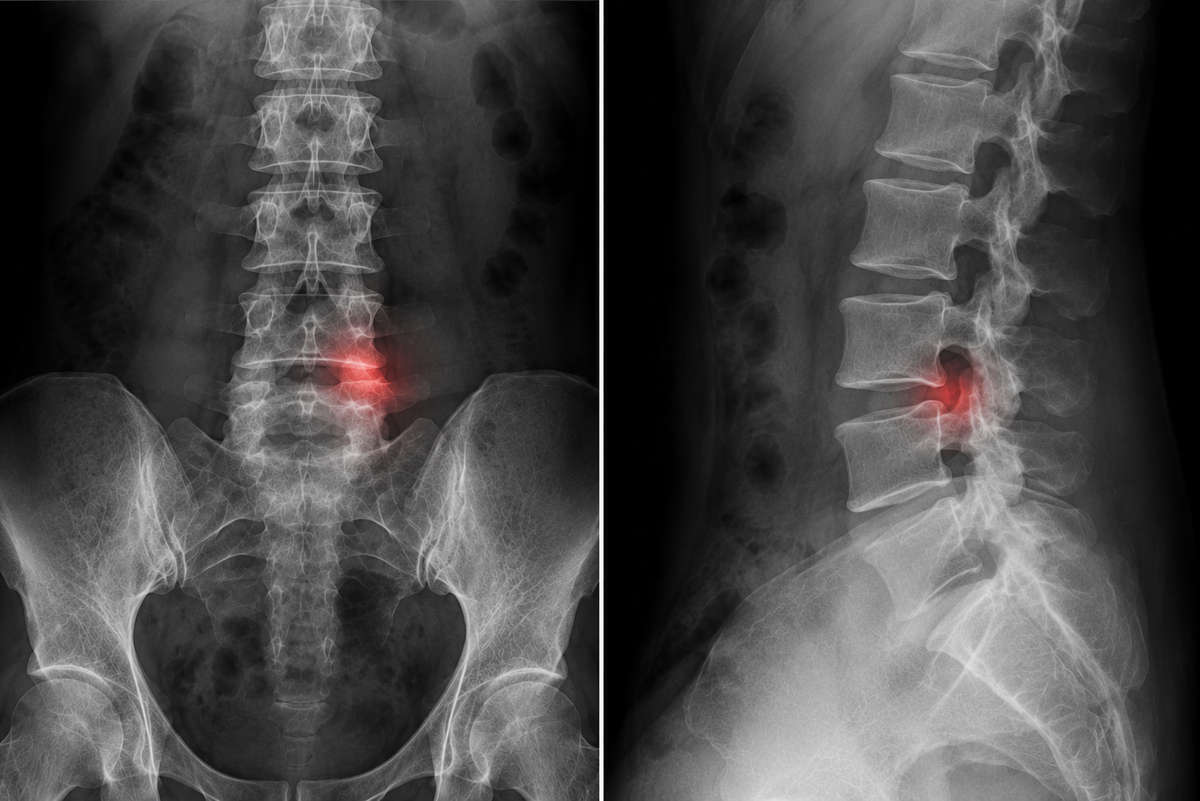
Herniated Disc Treatment in CA
Orthopedic Spine Surgeon — Long Beach & Torrance, CA
Medically reviewed by Brandon A. Ortega, MD · Last updated July 31, 2026
Herniated disc treatment focuses on relieving pain and neurological symptoms caused when displaced disc material irritates or compresses a spinal nerve or the spinal cord. Most patients improve without surgery through activity modification, physical therapy, medication, or injections. Surgery may be considered for persistent pain, progressive weakness, spinal cord compression, or emergency neurological symptoms.
What Is a Herniated Disc?
A herniated disc occurs when material from the soft center of a spinal disc pushes through a weakened or torn area in its outer layer. The displaced material may cause local neck or back pain, but arm or leg symptoms usually develop when it affects a nearby nerve. Some herniated discs cause no symptoms and require no treatment.
Spinal Disc Anatomy
Intervertebral discs sit between the vertebrae and help absorb force while allowing the spine to bend and move. Each disc contains:
- A soft, gel-like center called the nucleus
- A stronger outer ring called the annulus
- Cartilaginous endplates connecting the disc to the adjacent vertebrae
A tear or weakened area in the annulus can allow part of the nucleus to move outward toward the spinal canal or nerve openings.
Herniated vs. Bulging Disc
A bulging disc generally extends outward across a broader portion of its edge while the outer layer remains relatively contained. A herniated disc involves a more localized displacement of inner disc material through a tear or weakened portion of the outer layer.
These terms are sometimes used inconsistently. The more important question is whether the disc is irritating a nerve, compressing the spinal cord, or corresponding with the patient’s symptoms.
Where Herniated Discs Occur
Herniated discs can develop anywhere in the spine, but they occur most frequently in the lumbar spine and also commonly affect the cervical spine. Thoracic disc herniations are less common.
- Cervical spine: May affect the neck, shoulder, arm, or hand.
- Thoracic spine: May affect the middle back, ribs, torso, or spinal cord.
- Lumbar spine: May affect the lower back, buttock, leg, or foot.
Herniated Disc Symptoms
Symptoms depend on the location and direction of the herniation and which neurological structure is affected. A patient may experience local spinal pain, radiating nerve pain, altered sensation, weakness, or a combination of these symptoms.
Radiating Pain, Numbness and Tingling
A compressed or inflamed nerve may cause pain that travels away from the spine along the nerve’s pathway. Patients may describe the pain as sharp, burning, shooting, or electric.
Other nerve-related symptoms may include:
- Pins-and-needles sensations
- Numbness or reduced sensation
- Burning in an arm or leg
- Pain aggravated by coughing, sneezing, sitting, or certain movements
A lumbar herniation may cause sciatica in the buttock and leg, while a cervical herniation may cause pain or tingling through the shoulder, arm, or hand.
Muscle Weakness
More significant nerve compression may weaken the muscles controlled by the affected nerve.
Possible signs include:
- Reduced grip strength
- Difficulty lifting or controlling an arm
- Trouble lifting the front of the foot
- Difficulty standing on the toes or heels
- Foot drop
- Problems climbing stairs or walking normally
New or worsening weakness should be evaluated promptly because prolonged nerve compression may lead to incomplete neurological recovery.
Symptoms by Location
Cervical herniated disc symptoms may include neck pain, shoulder or arm pain, hand numbness, reduced grip strength, or weakness in an arm or hand. Spinal cord compression may also affect balance, coordination, and walking.
Thoracic herniated disc symptoms may include middle-back pain, pain around the chest or ribs, altered sensation around the torso, leg weakness, or walking difficulty. Thoracic herniations require careful evaluation because the spinal cord passes through this region.
Lumbar herniated disc symptoms may include lower-back pain, sciatica, numbness or tingling in the leg or foot, and weakness affecting walking or ankle control.
Emergency and Red-Flag Symptoms
Seek immediate medical care for:
- New loss of bladder or bowel control
- Difficulty starting or controlling urination
- Numbness around the groin, genitals, inner thighs, or buttocks
- Rapidly worsening arm or leg weakness
- Severe symptoms affecting both legs
- Sudden difficulty standing or walking
- Significant balance or coordination deterioration
A large lumbar herniation can cause cauda equina syndrome, a medical emergency involving compression of the lower spinal nerve roots. Severe cervical or thoracic compression can affect the spinal cord and also require urgent treatment.
Herniated Disc Treatments
Treatment depends on the disc’s location, symptom severity, neurological findings, imaging results, overall health, and effect on daily activities. Most patients begin with nonsurgical care unless progressive weakness, spinal cord compression, or emergency symptoms require earlier intervention.
Non-Surgical Treatment
Nonsurgical treatment may include:
- Temporary activity modification
- Gentle walking and continued movement
- Physical therapy
- Clinician-directed home exercises
- Anti-inflammatory or pain medication when appropriate
- Heat or cold therapy
- Epidural steroid or selective nerve-root injections
- Posture and lifting guidance
Physical therapy may improve flexibility, spinal support, posture, and movement mechanics. Prolonged bed rest is generally discouraged because inactivity can contribute to stiffness and weakness.
Injections may reduce inflammation and provide temporary relief around an irritated nerve, but they do not repair the disc itself. Many symptomatic herniations improve over several weeks or months without surgery.
Surgical Treatment
Surgery may be considered when pain remains disabling despite appropriate nonsurgical care, neurological weakness progresses, or imaging confirms compression that corresponds with the patient’s symptoms.
Possible procedures include:
- Microdiscectomy: Removes the portion of a herniated disc pressing on a nerve.
- Laminotomy or laminectomy: Removes bone or ligament to create more room around compressed nerves.
- Foraminotomy: Enlarges the opening through which a spinal nerve exits.
- Artificial disc replacement: Replaces a damaged cervical or lumbar disc in carefully selected patients.
- Spinal fusion: Stabilizes the spine when herniation is accompanied by instability, deformity, severe degeneration, or extensive reconstruction.
Selected discectomy and decompression procedures may be performed using minimally invasive tubular instruments, a microscope, or an endoscope. Disc replacement and fusion are not routinely required for an uncomplicated single-disc herniation.
Herniated Disc Treatment in CA Q&A
What’s the Difference Between a Herniated Disc and a Bulging Disc?
A bulging disc usually extends broadly beyond its normal boundary without a focal rupture. A herniated disc involves a more localized displacement of inner material through a weakened or torn outer layer.
Either finding may be painless or may compress a nerve. The severity of symptoms cannot be determined by the terminology alone.
What Does a Herniated Disc Feel Like?
A symptomatic herniated disc may cause localized neck or back pain, sharp pain traveling into an arm or leg, burning, tingling, numbness, or muscle weakness. Symptoms commonly worsen in positions or during movements that place additional pressure or tension on the affected nerve.
What Causes a Disc to Herniate?
Age-related disc degeneration is a common cause. As discs lose water and flexibility, their outer layers become more vulnerable to tearing. Lifting, bending, twisting, repetitive strain, trauma, excess body weight, and smoking may also contribute, although many patients cannot identify a single triggering event.
Can a Herniated Disc Heal on Its Own, and How Long Does It Take?
Many symptomatic herniated discs improve without surgery as inflammation decreases and displaced material gradually shrinks or is absorbed. Improvement often occurs over several weeks, although recovery may take a few months and some symptoms can persist or recur.
Improvement does not necessarily mean that the disc has returned completely to its original structure.
When Does a Herniated Disc Require Surgery?
Surgery may be recommended when disabling symptoms continue despite appropriate nonsurgical care, weakness is significant or worsening, spinal cord compression affects walking or coordination, or bladder and bowel symptoms indicate an emergency.
The decision should be based on the patient’s symptoms, neurological examination, imaging findings, and expected benefit from decompression.
What Is a Microdiscectomy?
A microdiscectomy is a focused decompression procedure that removes the portion of herniated disc material pressing on a spinal nerve. It is most commonly performed for a lumbar herniation causing persistent sciatica and may use a small incision, magnification, and specialized instruments.
Why Choose BAO Spine?
Fellowship-trained expertise
Advanced, subspecialty training in complex and minimally invasive spine surgery.
Conservative care first
Most patients improve without surgery — treatment begins with the least invasive options.
Motion-preserving techniques
Cervical and lumbar disc replacement that protects your natural range of motion.
Two convenient locations
Personalized spine care in both Long Beach and Torrance, California.

About Dr. Ortega
Brandon A. Ortega, MD, is a fellowship-trained orthopedic spine surgeon providing comprehensive, personalized spinal care to adults in Long Beach and Torrance, California. His dedication to helping each patient regain mobility, reduce pain, and improve their quality of life has earned the respect of everyone in the community struggling with neck and back pain.
Consultation
Get expert care for herniated disc treatment in CA
Request an appointment and Brandon A. Ortega, MD's team will reach out to schedule your visit — fellowship-trained, personalized spine care.
Prefer to call? Contact us.