
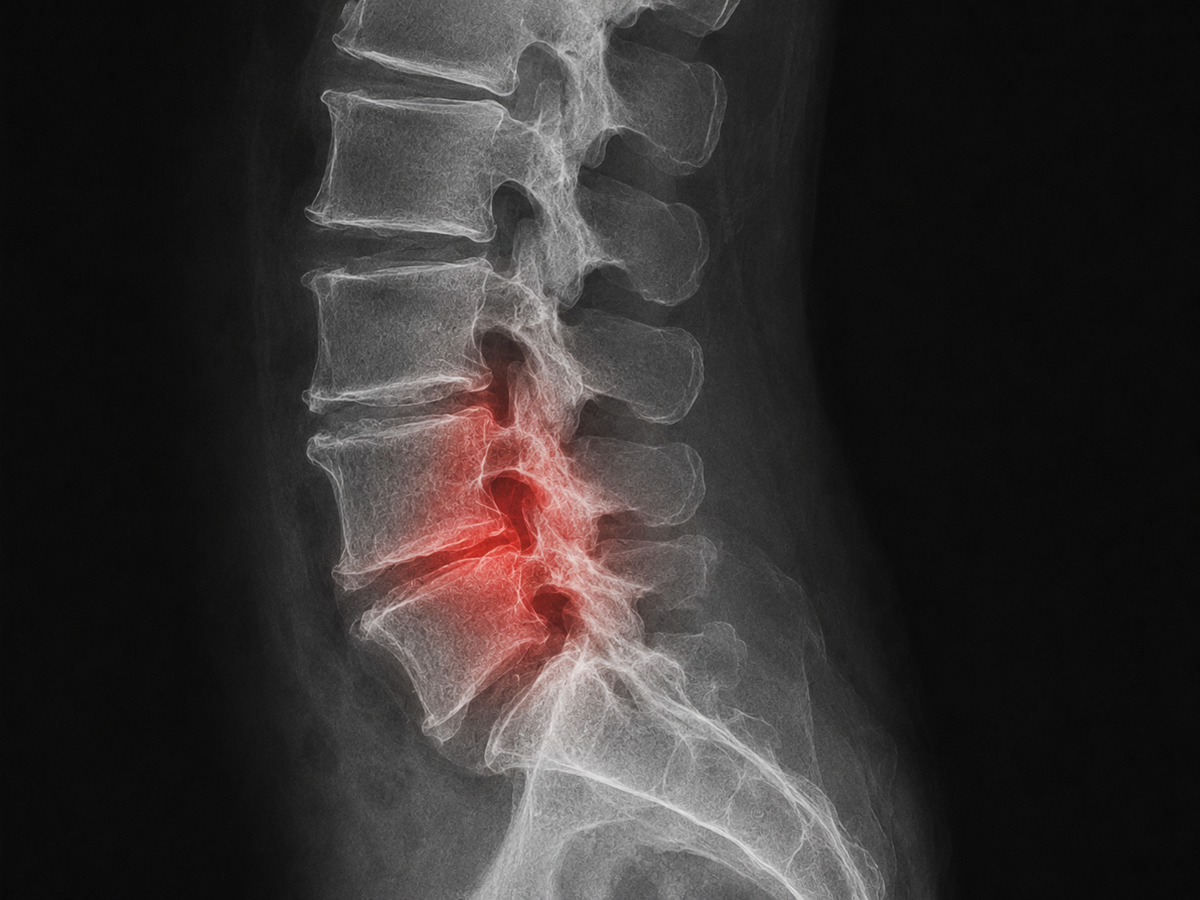
Degenerative Disc Disease Treatment in Los Angeles
Orthopedic Spine Surgeon — Long Beach & Torrance, CA
Medically reviewed by Brandon A. Ortega, MD · Last updated July 31, 2026
Degenerative disc disease treatment focuses on reducing neck or lower-back pain, improving mobility, and addressing nerve symptoms associated with worn spinal discs. Most patients begin with physical therapy, medication, activity changes, or injections. Artificial disc replacement or spinal fusion may be considered when symptoms remain disabling and testing identifies a specific disc that can be treated surgically.
What Is Degenerative Disc Disease?
Degenerative disc disease, commonly abbreviated as DDD, describes age-related deterioration of the discs between the vertebrae. Despite its name, it is not technically a disease. Some degree of disc degeneration is a normal part of aging and may appear on imaging without causing pain.
Symptoms may develop when degeneration causes inflammation, loss of disc height, abnormal movement, nerve compression, or increased stress on nearby joints.
How Spinal Discs Wear Down With Age
Spinal discs act as cushions between adjacent vertebrae and help the spine absorb force, bend, and rotate. Each disc contains a water-rich inner portion surrounded by a stronger outer ring.
With age, a disc may:
- Lose water and become less flexible
- Become thinner as disc height decreases
- Develop cracks or tears in its outer layer
- Bulge or herniate
- Place additional stress on nearby joints
- Contribute to bone-spur formation or spinal narrowing
These structural changes do not always produce symptoms. A diagnosis should consider the patient’s pain pattern, examination findings, and imaging rather than relying on an MRI result alone.
Lumbar vs. Cervical DDD
Lumbar degenerative disc disease affects the lower back and is the most common form because the lumbar spine supports substantial body weight and movement. It may cause localized lower-back pain or contribute to sciatica when nearby nerves become compressed.
Cervical degenerative disc disease affects the neck. Symptoms may include neck stiffness, headaches, shoulder or arm pain, numbness, tingling, or weakness. Advanced degeneration can contribute to cervical spinal stenosis or spinal-cord compression.
Single-Level vs. Multilevel Degeneration
Single-level degeneration affects one disc, while multilevel degeneration involves two or more spinal levels. Multilevel changes may occur entirely within the neck or lower back, or in more than one spinal region.
The number of worn discs does not necessarily determine symptom severity. One severely symptomatic level may cause greater difficulty than several mildly degenerated levels. Identifying which level—if any—is responsible for the symptoms is particularly important before surgery is considered.
The Stages of Degenerative Disc Disease
Disc degeneration develops gradually, but progression does not follow the same pattern in every patient. Symptoms may flare, remain stable, or improve even though structural changes remain visible on imaging.
The 4 Stages of Disc Degeneration
A four-stage model is sometimes used to explain degenerative disc disease:
- Dysfunction: Early disc deterioration begins, potentially causing mild or intermittent pain.
- Dehydration: The disc loses water, flexibility, and some height.
- Stabilization: The body attempts to stabilize the affected segment, potentially producing bone spurs, arthritis, or spinal stenosis.
- Collapse: Advanced disc-height loss can increase bone contact, joint stress, and nerve compression.
This is a simplified clinical model rather than the only accepted classification. Radiologists and spine specialists may use other grading systems, including the five-grade Pfirrmann MRI classification.
Mild, Moderate and Severe DDD
Mild DDD may involve early dehydration or small structural changes with occasional stiffness or discomfort.
Moderate DDD may involve greater disc-height loss, more frequent pain, reduced flexibility, bone spurs, or early nerve-space narrowing.
Severe DDD may involve substantial disc collapse, spinal instability, stenosis, deformity, or nerve compression producing weakness, numbness, or radiating pain.
Imaging severity does not always match symptom severity. Some patients with advanced degeneration have limited pain, while others with less dramatic imaging changes experience substantial symptoms.
Does DDD Get Worse Over Time?
The structural changes associated with disc degeneration generally do not reverse, but progression is often slow and varies widely. Symptoms may improve through strengthening, activity modification, weight management, and other treatment even when the disc remains degenerated.
Factors that may accelerate degeneration or symptoms include smoking, excess body weight, physically demanding work, injury, diabetes, and genetic predisposition.
Degenerative Disc Disease Symptoms
DDD symptoms depend on the spinal region involved, whether nerves are affected, and which activities place stress on the damaged disc.
Lower Back Symptoms
Lumbar DDD may cause:
- Aching or stiffness in the lower back
- Pain centered near or above the belt line
- Pain that worsens with sitting, bending, lifting, or twisting
- Flare-ups lasting days, weeks, or longer
- Reduced flexibility
- Pain that improves when lying down or changing position
- Buttock or leg symptoms when a nerve is affected
Disc-related lower-back pain is often mechanical, meaning it changes with posture, movement, and spinal loading.
Neck Symptoms
Cervical DDD may cause:
- Neck pain or stiffness
- Reduced range of motion
- Pain around the shoulder blades
- Headaches associated with neck tension
- Pain traveling into an arm
- Hand or finger numbness
- Arm or hand weakness
When degeneration narrows the spinal canal and compresses the spinal cord, patients may also develop hand clumsiness, balance problems, leg stiffness, or difficulty walking.
Radiating Pain and Flare-Up Patterns
Degenerative disc pain may come and go, with episodes lasting weeks or months. Symptoms may worsen after prolonged sitting, heavy lifting, repetitive bending, twisting, or high-impact activity.
Pain that travels into an arm or leg usually suggests that degeneration, disc herniation, bone spurs, or reduced disc height is affecting a nerve. Other nerve-related symptoms may include numbness, tingling, burning, or muscle weakness.
New or progressive weakness, balance loss, bladder or bowel dysfunction, or numbness around the groin requires prompt medical assessment.
Degenerative Disc Disease Treatments
Treatment should address the patient’s symptoms and functional limitations—not imaging changes alone. Nonsurgical care is generally attempted first unless severe neurological compression, instability, or another urgent problem is present.
Non-Surgical Treatment
Conservative treatment may include:
- Physical therapy
- Core or neck-strengthening exercises
- Flexibility and posture training
- Clinician-approved medication
- Heat or cold therapy
- Activity modification
- Low-impact exercise
- Epidural steroid or facet-joint injections
- Weight management
- Smoking cessation
Physical therapy may help improve spinal support, mobility, posture, and tolerance for everyday activities. Walking, swimming, and other low-impact activities may be easier on the discs than repetitive heavy lifting or high-impact exercise.
Injections may reduce inflammation or help identify whether a nerve or joint is contributing to pain. Relief may be temporary, and injections do not restore a worn disc to its original condition.
Surgical Treatment
Surgery may be considered when symptoms remain severe despite an appropriate course of nonsurgical care and evaluation identifies a specific structural problem that surgery can reasonably address.
Potential procedures include:
- Artificial disc replacement: The damaged disc is removed and replaced with a motion-preserving implant in carefully selected cervical or lumbar patients.
- Spinal fusion: The damaged level is stabilized by joining adjacent vertebrae.
- Discectomy or decompression: Disc material, bone, or ligament compressing a nerve is removed.
- Foraminotomy or laminectomy: Additional space is created around affected nerves.
Disc replacement generally requires good bone quality, suitable spinal alignment, and limited facet-joint arthritis. Fusion may be more appropriate when degeneration is accompanied by instability, deformity, advanced arthritis, or vertebral slippage.
Surgery is not usually recommended simply because several discs appear degenerated on imaging. The surgeon must determine whether the proposed procedure is likely to improve the patient’s specific symptoms.
Degenerative Disc Disease Treatment in Los Angeles Q&A
What Are the Symptoms of Degenerative Disc Disease?
Common symptoms include neck or lower-back pain, stiffness, reduced flexibility, and pain that worsens with sitting, bending, twisting, or lifting. Nerve compression may also cause pain, numbness, tingling, or weakness in an arm or leg.
What Are the 4 Stages of Degenerative Disc Disease?
The four commonly described stages are dysfunction, dehydration, stabilization, and collapse. These stages provide a simplified explanation of progression from early disc wear to advanced loss of disc height and possible nerve compression. Other medical grading systems may be used when interpreting imaging.
What Causes Degenerative Disc Disease?
DDD develops through a combination of natural aging, genetics, environmental exposure, injuries, and lifestyle factors. Smoking, obesity, diabetes, and repetitive physical loading may contribute to faster degeneration or more severe symptoms.
Can Degenerative Disc Disease Be Treated Without Surgery?
Yes. Most patients begin with physical therapy, medication, exercise, activity changes, weight management, or injections. These treatments cannot reverse the structural degeneration but may substantially reduce symptoms and improve function.
When Is Surgery Necessary for Degenerative Disc Disease?
Surgery may be considered when persistent pain or neurological symptoms substantially limit daily activities, nonsurgical care has not provided adequate improvement, and testing identifies a treatable symptomatic level. Progressive weakness, spinal-cord compression, or significant instability may support earlier surgical evaluation.
Why Choose BAO Spine?
Fellowship-trained expertise
Advanced, subspecialty training in complex and minimally invasive spine surgery.
Conservative care first
Most patients improve without surgery — treatment begins with the least invasive options.
Motion-preserving techniques
Cervical and lumbar disc replacement that protects your natural range of motion.
Two convenient locations
Personalized spine care in both Long Beach and Torrance, California.

About Dr. Ortega
Brandon A. Ortega, MD, is a fellowship-trained orthopedic spine surgeon providing comprehensive, personalized spinal care to adults in Long Beach and Torrance, California. His dedication to helping each patient regain mobility, reduce pain, and improve their quality of life has earned the respect of everyone in the community struggling with neck and back pain.
Consultation
Get expert care for degenerative disc disease treatment in Los Angeles
Request an appointment and Brandon A. Ortega, MD's team will reach out to schedule your visit — fellowship-trained, personalized spine care.
Prefer to call? Contact us.