
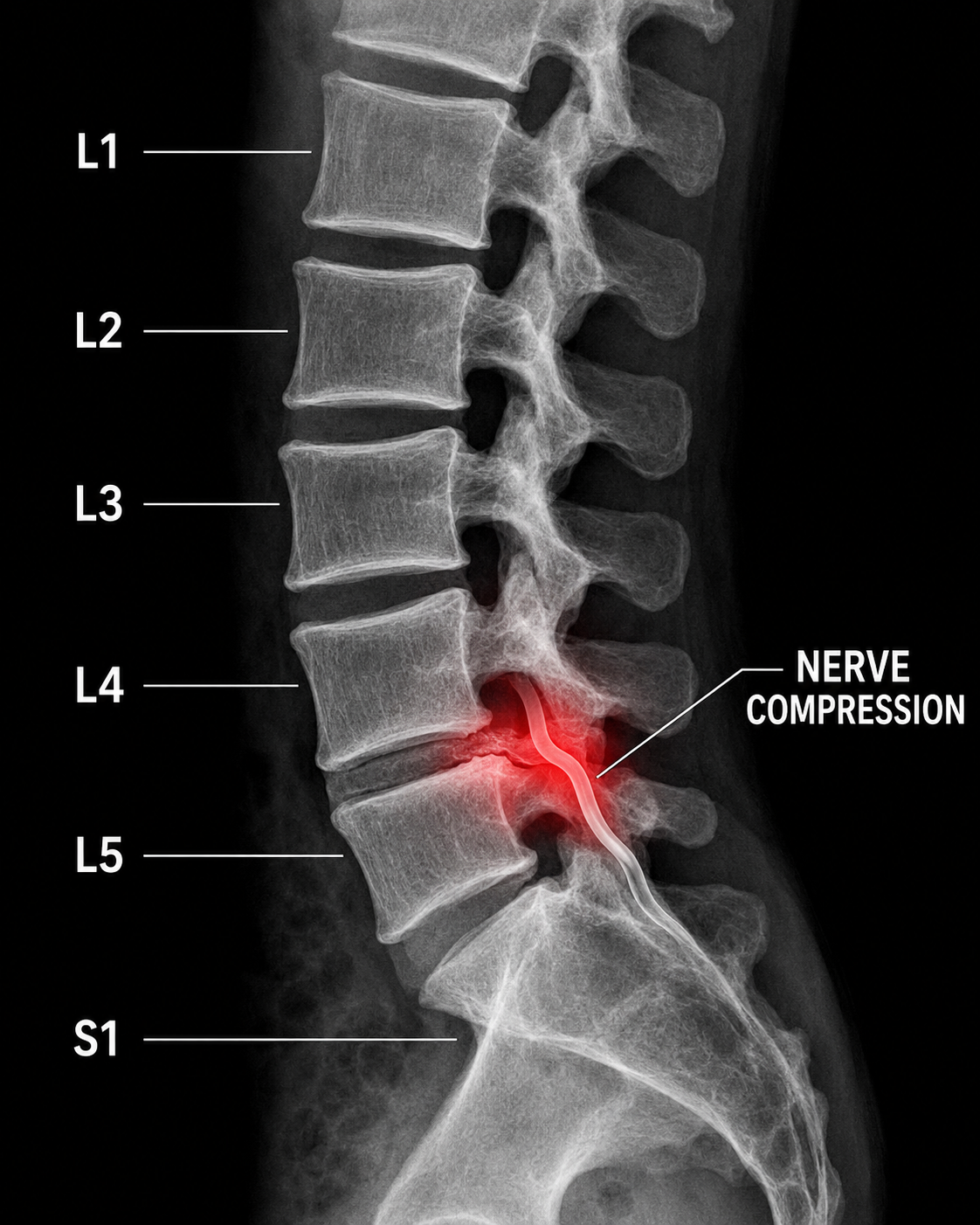
Nerve Compression Treatment in Los Angeles
Orthopedic Spine Surgeon — Long Beach & Torrance, CA
Medically reviewed by Brandon A. Ortega, MD · Last updated July 31, 2026
Nerve compression occurs when surrounding bone, disc material, ligaments, or other tissues place excessive pressure on a nerve or the spinal cord. This pressure can interfere with normal nerve function, causing pain, numbness, tingling, burning sensations, muscle weakness, or problems with coordination. At BAO Spine, patients receive individualized evaluation and treatment for nerve compression affecting the cervical, thoracic, and lumbar spine. Depending on the cause and severity of the compression, treatment may include physical therapy, medication, spinal injections, or a surgical decompression procedure. The appropriate treatment depends on where the compression occurs, how long symptoms have been present, whether weakness or spinal cord symptoms are developing, and how the condition affects normal activities.
What Is Nerve Compression?
Nerves carry signals between the brain, spinal cord, and the rest of the body. When a nerve is compressed or irritated, those signals may be disrupted.
Spinal nerve compression commonly develops where a nerve root branches away from the spinal cord and exits through an opening between adjacent vertebrae. Compression may also affect the spinal cord itself when the spinal canal becomes too narrow.
Although the terms “pinched nerve,” “nerve compression,” “radiculopathy,” and “spinal cord compression” are sometimes used interchangeably, they describe different neurological problems.
Pinched Nerves vs. Spinal Cord Compression
A pinched nerve usually refers to compression or irritation of an individual spinal nerve root. When this occurs in the neck, it is called cervical radiculopathy. When it occurs in the lower back, it may be described as lumbar radiculopathy or sciatica, depending on the affected nerve.
Nerve root compression typically causes symptoms that follow the path of the affected nerve. A compressed cervical nerve may produce pain, numbness, tingling, or weakness in one shoulder, arm, or hand. A compressed lumbar nerve may cause similar symptoms in the buttock, thigh, calf, or foot.
Spinal cord compression affects the bundle of nerve tissue running through the spinal canal. Compression of the cervical spinal cord may cause cervical myelopathy, which can affect both the arms and legs.
Spinal cord compression can cause balance problems, walking difficulty, loss of hand coordination, weakness, abnormal reflexes, or changes in bowel and bladder control. Because the spinal cord controls many areas of the body, cord compression can be more serious than compression of a single nerve root.
Common Causes of Nerve Compression
Spinal nerves may become compressed for several reasons, including:
Herniated discs: The soft material inside a spinal disc may push through its outer layer and press against a nearby nerve root.
Degenerative disc disease: As a disc loses height and hydration, the space available for the spinal nerves may become smaller.
Spinal stenosis: Age-related changes, thickened ligaments, enlarged facet joints, or bone spurs may narrow the spinal canal or nerve openings.
Bone spurs: Osteoarthritis may cause additional bone growth around the vertebrae and facet joints. These growths can reduce the space around a nerve.
Spondylolisthesis: A vertebra that slips out of alignment can narrow the spinal canal or foramen and compress nearby nerves.
Spinal injuries: Fractures, dislocations, swelling, or damaged discs may place sudden pressure on the nerves or spinal cord.
Less commonly, nerve compression may result from a spinal infection, cyst, or tumor. Identifying the underlying cause is important because treatments vary considerably between these conditions.
Where Nerve Compression Occurs
Nerve compression can occur at any level of the spine, but it is most frequently diagnosed in the cervical and lumbar regions.
Cervical nerve compression affects the neck and may cause symptoms that travel into the shoulder, arm, hand, or fingers. Compression of the cervical spinal cord may also affect walking, balance, coordination, and lower-body function.
Thoracic nerve compression affects the middle and upper back. It may cause pain, numbness, or burning that travels around the ribs or chest. Significant thoracic spinal cord compression may affect the torso and legs.
Lumbar nerve compression affects the lower back and may cause symptoms that travel through the buttock and leg. Compression of the nerve roots that contribute to the sciatic nerve is a common cause of sciatica.
The location and pattern of symptoms often help identify which nerve is affected, but imaging and a neurological examination may be needed to confirm the diagnosis.
Nerve Compression Symptoms
Symptoms depend on the location, cause, and severity of the compression. Mild irritation may cause intermittent discomfort, while significant or prolonged pressure may interfere with sensation, strength, coordination, or mobility.
Some symptoms worsen during particular movements or positions. Others may become persistent as the underlying condition progresses.
Radiating Pain
A compressed spinal nerve often causes pain that travels away from the spine and into another part of the body.
Cervical nerve compression may cause pain that begins in the neck and travels through the shoulder or arm. Lumbar nerve compression may cause pain that begins in the lower back or buttock and travels into the thigh, calf, or foot.
The pain may feel sharp, electric, aching, or similar to a sudden shock. Coughing, sneezing, bending, lifting, or turning the neck may aggravate symptoms in some patients.
Numbness, Tingling, and Burning
A compressed nerve may cause altered sensation along the area supplied by that nerve. Symptoms can include:
- Numbness
- Pins-and-needles sensations
- Burning discomfort
- Increased sensitivity
- Reduced ability to feel temperature or touch
A cervical nerve problem may affect particular fingers or areas of the hand. Lumbar nerve compression may affect part of the thigh, lower leg, heel, or foot.
The location of these sensory changes can help a spine specialist identify the affected nerve root.
Muscle Weakness
Motor nerves control muscle movement. When these nerves are compressed, specific muscles may become weak.
Cervical nerve compression may make it difficult to grip objects, lift the arm, straighten the elbow, or perform precise hand movements. Lumbar nerve compression may cause difficulty climbing stairs, lifting the foot, standing on the toes, or rising from a chair.
Weakness is an important neurological symptom and should not be ignored, particularly when it is worsening. Prolonged or severe nerve compression may cause lasting nerve or muscle impairment.
Red-Flag Symptoms
Certain symptoms may indicate serious spinal cord or nerve compression and require immediate medical evaluation.
Seek urgent or emergency care for:
- New loss of bowel or bladder control
- Difficulty beginning urination or inability to empty the bladder
- Numbness around the groin, inner thighs, or buttocks
- Rapidly worsening arm or leg weakness
- Sudden difficulty walking or maintaining balance
- Loss of coordination in the hands
- Symptoms affecting both arms or both legs
- Severe symptoms following a fall, collision, or other spinal injury
- Back or neck pain accompanied by fever, unexplained weight loss, or a history of cancer
Compression of the cauda equina—the bundle of nerve roots at the bottom of the spinal canal—is a surgical emergency. Prompt evaluation is important because delayed treatment may lead to permanent neurological impairment.
Nerve Compression Treatments
Treatment begins by identifying the source of the compression and determining whether it affects a nerve root, the spinal cord, or both.
The evaluation may include a physical and neurological examination to assess strength, sensation, reflexes, coordination, posture, and walking ability. X-rays may reveal spinal alignment problems or bone spurs, while an MRI can show discs, nerves, ligaments, and the spinal cord.
Electromyography and nerve-conduction studies may sometimes be used to determine how well a nerve is functioning or to distinguish spinal nerve compression from a peripheral nerve condition.
Non-Surgical Treatment
Many patients with mild or moderate nerve root compression improve without surgery. Nonsurgical treatment may include:
Activity modification: Temporarily reducing movements or activities that aggravate the affected nerve may allow inflammation to improve.
Physical therapy: A rehabilitation program may include exercises to improve posture, flexibility, spinal support, strength, and movement mechanics. Cervical or lumbar traction may be appropriate for selected patients.
Medication: Anti-inflammatory medication, pain relievers, muscle relaxants, or medications used for nerve pain may be recommended depending on the patient’s symptoms and medical history.
Spinal injections: An epidural steroid injection may reduce inflammation around an irritated nerve root. A selective nerve-root injection may also help determine which nerve is responsible for the symptoms.
Lifestyle adjustments: Weight management, ergonomic changes, improved lifting techniques, and modifications to repetitive activities may reduce stress on the spine.
Nonsurgical care does not physically remove a bone spur or herniated disc. However, symptoms may improve as inflammation decreases and the body adapts or heals.
Patients with signs of spinal cord compression, progressive weakness, or severe neurological dysfunction may require a more urgent surgical evaluation rather than an extended course of conservative care.
Surgical Decompression Options
Surgical decompression creates more room for a compressed nerve or the spinal cord. The procedure selected depends on the location of the compression, its underlying cause, spinal stability, and whether one or multiple levels are affected.
Discectomy or microdiscectomy removes the portion of a herniated disc pressing against a nerve. A lumbar microdiscectomy may be performed through a relatively small incision using specialized instruments or magnification.
Foraminotomy enlarges the opening through which a spinal nerve exits. Bone, disc material, or soft tissue may be removed to relieve pressure on the nerve root.
Laminotomy removes part of the lamina, which forms the back portion of the spinal canal. This can provide additional space while preserving more of the surrounding bone.
Laminectomy removes a larger portion or all of the lamina to expand the spinal canal. It may be performed for lumbar stenosis, cervical myelopathy, or other forms of central spinal compression.
Laminoplasty expands the cervical spinal canal while preserving part of the lamina. It may be considered for selected patients with multilevel cervical spinal cord compression.
Anterior cervical discectomy and fusion, or ACDF, removes a damaged cervical disc through the front of the neck. The spinal level is then stabilized with a bone graft or spacer and, when appropriate, fixation hardware.
Cervical disc replacement removes the damaged disc and replaces it with an artificial disc. This motion-preserving option may be appropriate for selected patients with cervical nerve root or spinal cord compression who do not have significant instability or deformity.
Spinal fusion may be added when the affected spinal segment is unstable, when decompression would create instability, or when conditions such as spondylolisthesis or significant deformity are present.
Some decompression procedures can be performed using minimally invasive techniques. However, the safest and most appropriate approach depends on the patient’s anatomy and the complexity of the compression.
At BAO Spine, surgical recommendations are based on the location and severity of nerve compression, neurological findings, imaging results, spinal stability, and the patient’s individual treatment goals.
Nerve Compression Treatment in Los Angeles Q&A
What Causes a Compressed or Pinched Nerve?
A spinal nerve may become compressed by a herniated disc, bone spur, spinal stenosis, thickened ligament, degenerative disc disease, slipped vertebra, or spinal injury.
These conditions can reduce the amount of space available for a nerve root or the spinal cord. Less commonly, infection, cysts, or tumors may cause compression.
What Are the Symptoms of Nerve Compression?
Common symptoms include radiating pain, numbness, tingling, burning sensations, and muscle weakness.
The location of symptoms depends on which nerve is affected. Cervical nerve compression generally affects the shoulder, arm, or hand, while lumbar nerve compression may affect the buttock, leg, or foot.
Spinal cord compression may also cause balance problems, loss of coordination, difficulty walking, or changes in bowel and bladder function.
What Is the Difference Between a Pinched Nerve and Spinal Cord Compression?
A pinched nerve generally affects one spinal nerve root and causes symptoms along that nerve’s pathway. This condition is often called radiculopathy.
Spinal cord compression affects the central bundle of nerves within the spinal canal. It can produce broader symptoms involving both sides of the body, including weakness, balance difficulty, impaired hand coordination, and changes in walking.
Spinal cord compression is generally more urgent because continued pressure may cause permanent neurological damage.
Can Nerve Compression Be Treated Without Surgery?
Yes. Many cases of nerve root compression improve with activity modification, physical therapy, medication, and spinal injections.
The likelihood of improvement without surgery depends on the cause of the compression, symptom severity, neurological findings, and how long the symptoms have been present.
Nonsurgical treatment may not be appropriate when compression causes progressive muscle weakness, spinal cord dysfunction, cauda equina syndrome, or another neurological emergency.
When Does Nerve Compression Require Surgery?
Surgery may be considered when pain, numbness, or weakness persists despite an appropriate period of nonsurgical treatment.
Earlier surgery may be recommended when there is progressive weakness, severe nerve compression, spinal instability, spinal cord dysfunction, or loss of bowel or bladder control.
The purpose of surgery is to remove pressure from the affected neurological structures. Fusion or another stabilization procedure may also be needed when the spine is unstable.
Why Choose BAO Spine?
Fellowship-trained expertise
Advanced, subspecialty training in complex and minimally invasive spine surgery.
Conservative care first
Most patients improve without surgery — treatment begins with the least invasive options.
Motion-preserving techniques
Cervical and lumbar disc replacement that protects your natural range of motion.
Two convenient locations
Personalized spine care in both Long Beach and Torrance, California.

About Dr. Ortega
Brandon A. Ortega, MD, is a fellowship-trained orthopedic spine surgeon providing comprehensive, personalized spinal care to adults in Long Beach and Torrance, California. His dedication to helping each patient regain mobility, reduce pain, and improve their quality of life has earned the respect of everyone in the community struggling with neck and back pain.
Consultation
Get expert care for nerve compression treatment in Los Angeles
Request an appointment and Brandon A. Ortega, MD's team will reach out to schedule your visit — fellowship-trained, personalized spine care.
Prefer to call? Contact us.