
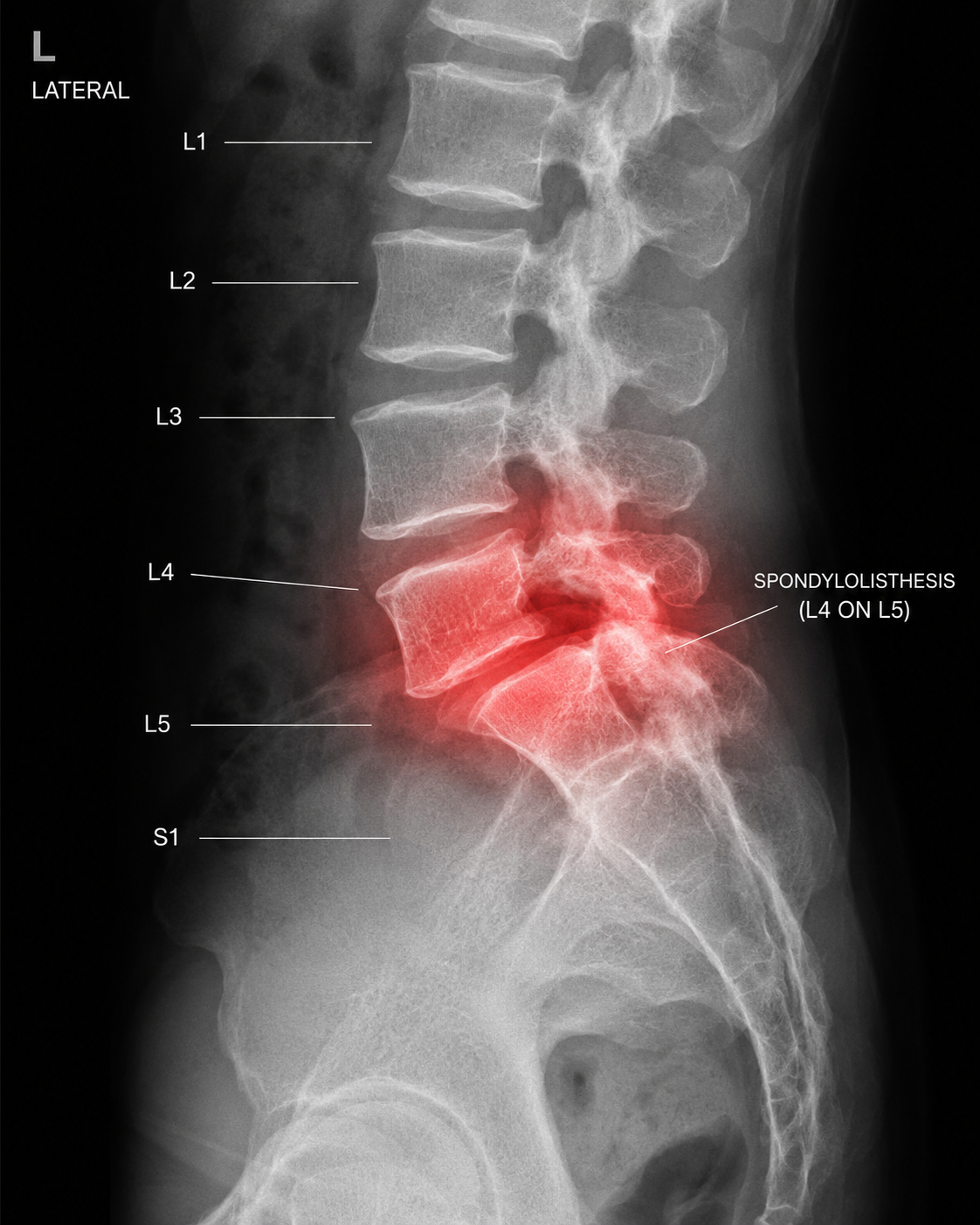
Spondylolisthesis Treatment in Los Angeles
Orthopedic Spine Surgeon — Long Beach & Torrance, CA
Medically reviewed by Brandon A. Ortega, MD · Last updated July 31, 2026
Spondylolisthesis occurs when one vertebra slips forward relative to the vertebra beneath it. Depending on the degree of movement and whether nearby nerves are affected, the condition may cause lower back pain, stiffness, sciatica, numbness or weakness in the legs. At BAO Spine, we provide personalized spondylolisthesis treatment in Los Angeles for patients with mild, moderate and advanced spinal instability. Treatment may include physical therapy, medication, targeted spinal injections or surgery when conservative care does not provide sufficient relief. The right treatment depends on several factors, including the cause and grade of the slippage, the severity of your symptoms, the presence of nerve compression and the effect the condition has on your mobility and quality of life.
What Is Spondylolisthesis?
Spondylolisthesis is a spinal condition in which a vertebra moves out of its normal position. It most commonly affects the lumbar spine, or lower back, particularly the L4-L5 and L5-S1 levels.
A small amount of vertebral movement may cause few or no symptoms. More significant slippage can alter spinal alignment, narrow the space available for the nerves and contribute to persistent back or leg pain.
How a Vertebra Slips Out of Place
Each vertebra is supported by spinal discs, facet joints, ligaments and surrounding muscles. These structures work together to stabilize the spine while allowing it to bend and move.
A vertebra may begin to slip when part of this support system becomes weakened or damaged. This may occur because of age-related degeneration, a stress fracture, abnormal spinal development or a traumatic injury.
As the vertebra moves forward, it can place additional strain on the discs and joints. In some patients, the movement also compresses or irritates a spinal nerve, producing symptoms that travel into the buttocks or legs.
Types of Spondylolisthesis
The type of spondylolisthesis is determined by what caused the vertebra to slip.
Degenerative spondylolisthesis develops as the discs and facet joints wear down over time. These changes may make the spinal segment less stable, allowing one vertebra to move forward. It is more commonly diagnosed in middle-aged and older adults.
Isthmic spondylolisthesis is associated with a defect or stress fracture in a portion of the vertebra called the pars interarticularis. The weakened area may allow the vertebral body to move forward. The original stress injury may develop during childhood or adolescence, although symptoms may not appear until adulthood.
Congenital or dysplastic spondylolisthesis results from differences in spinal development that are present at birth. Abnormally formed vertebrae or facet joints may make the spine more susceptible to instability and slippage.
Traumatic spondylolisthesis occurs when an accident or other forceful injury damages the structures responsible for stabilizing the spine.
Grades of Slippage
Spondylolisthesis is commonly classified using the Meyerding grading system. The grade describes how far the upper vertebra has moved forward in relation to the vertebra beneath it:
- Grade I: Up to 25% slippage
- Grade II: 26% to 50% slippage
- Grade III: 51% to 75% slippage
- Grade IV: 76% to 100% slippage
- Grade V: More than 100% slippage, also called spondyloptosis
Grades I and II are considered low-grade slips. Grades III and IV are considered high-grade slips and may be more likely to cause significant instability or neurological symptoms.
However, the grade alone does not determine whether surgery is necessary. Symptoms, nerve compression, spinal alignment and progression of the condition must also be considered.
Spondylolisthesis Symptoms
Spondylolisthesis does not always cause symptoms. Some patients discover a low-grade slip during an imaging study performed for an unrelated reason.
When symptoms do occur, they can vary depending on the location of the affected vertebra, the degree of instability and whether the spinal nerves are compressed.
Lower Back Pain and Stiffness
Aching lower back pain is one of the most common symptoms of lumbar spondylolisthesis. Pain may worsen during prolonged standing, walking, lifting or activities that require arching the lower back.
Some patients also experience stiffness, muscle spasms or a reduced range of motion. The discomfort may improve with sitting, bending forward or resting.
Radiating Leg Pain and Sciatica
When the slipped vertebra narrows the spinal canal or the openings through which the nerves exit, it can irritate a lumbar nerve root. This may cause radiating pain that travels from the lower back into the buttock, thigh, calf or foot.
This pattern of nerve pain is commonly called sciatica. Depending on the affected nerve, symptoms may occur on one or both sides of the body.
Numbness, Tingling and Weakness
Nerve compression may also cause numbness, tingling or a pins-and-needles sensation in the legs or feet. Some patients notice weakness when climbing stairs, standing from a seated position or walking for an extended period.
Progressive weakness should be evaluated promptly. Seek emergency medical attention for new loss of bowel or bladder control, numbness around the groin or inner thighs, or rapidly worsening leg weakness.
Tight Hamstrings and Changes in Posture or Gait
Spondylolisthesis may cause chronic tightness in the hamstring muscles. This can affect posture and make it difficult to stand fully upright.
Patients with more pronounced slippage may walk with shortened steps, bent knees or a forward-leaning posture. Children and adolescents with high-grade spondylolisthesis may also develop a noticeable change in the shape or alignment of the lower back.
Spondylolisthesis Treatments
Treatment begins with a detailed evaluation of your symptoms, medical history, neurological function and spinal alignment.
X-rays are commonly used to identify and measure vertebral slippage. Flexion-extension X-rays may help evaluate instability, while an MRI can show whether the spinal nerves are compressed.
The goal of treatment is not simply to address an imaging finding. It is to reduce pain, protect neurological function, improve mobility and help you return to normal activities.
Non-Surgical Treatment
Many patients with low-grade spondylolisthesis improve without surgery. A conservative treatment plan may include:
Physical therapy: A structured rehabilitation program can strengthen the abdominal, back and hip muscles that support the spine. Therapy may also address hamstring tightness, posture, flexibility and movement patterns that aggravate symptoms.
Activity modification: Temporarily avoiding repetitive bending, heavy lifting, high-impact exercise or movements that increase pain may allow irritated tissues to recover.
Medication: Anti-inflammatory medications, pain relievers or other medications may be recommended depending on your symptoms and overall health. Medication should be used under the direction of a qualified medical professional.
Bracing: A back brace may be considered in selected cases, particularly when a stress fracture or significant instability is present. Bracing is not appropriate or necessary for every patient.
Spinal injections: An epidural steroid injection may reduce inflammation around a compressed nerve and provide temporary relief from radiating leg pain. Injections do not correct the vertebral slippage, but they may make it easier to participate in physical therapy and daily activities.
Most patients with spondylolysis or low-grade spondylolisthesis are initially treated without surgery.
Surgical Treatment
Surgery may be considered when symptoms remain severe despite an appropriate course of conservative care. It may also be recommended for progressive neurological weakness, high-grade slippage, worsening instability or pain that substantially limits standing, walking, work or daily activities.
The two principal components of spondylolisthesis surgery are decompression and stabilization.
Spinal decompression removes bone, ligament or other tissue pressing on the spinal nerves. Procedures such as a laminectomy or foraminotomy may be used to create more room for the affected nerve roots.
Spinal fusion stabilizes the affected vertebrae so they can no longer move abnormally against one another. Bone graft material is placed between the vertebrae, and screws or rods may be used to hold the spine in a stable position while the bones heal together.
In some cases, decompression and fusion are performed during the same operation. Whether the slipped vertebra should be partially realigned depends on the type and grade of spondylolisthesis, spinal balance, nerve anatomy and the surgeon’s treatment plan.
At BAO Spine, each surgical recommendation is based on the patient’s specific anatomy, symptoms and treatment goals. Surgery is recommended only when its expected benefits justify its potential risks.
Spondylolisthesis Treatment in Los Angeles Q&A
What Causes a Vertebra to Slip?
A vertebra may slip because of age-related deterioration of the spinal discs and joints, a stress fracture in the pars interarticularis, abnormal spinal development or a traumatic injury.
Less commonly, spinal disease or previous surgery may weaken the structures that stabilize the vertebrae.
What Are the Symptoms of Spondylolisthesis?
Symptoms may include lower back pain, stiffness, muscle tightness, sciatica, numbness, tingling or weakness in the legs.
Some patients have difficulty standing or walking for extended periods. Low-grade spondylolisthesis may cause no noticeable symptoms.
What Do the Different Grades of Spondylolisthesis Mean?
The grade measures the percentage of forward movement between two vertebrae.
Grade I represents up to 25% slippage, Grade II represents 26% to 50%, Grade III represents 51% to 75% and Grade IV represents 76% to 100%. Grade V describes movement greater than 100%.
The grade helps describe the condition, but it does not automatically determine treatment. A patient with a low-grade slip may have significant nerve pain, while another patient with more visible slippage may have relatively mild symptoms.
Can Spondylolisthesis Be Treated Without Surgery?
Yes. Many patients, particularly those with low-grade spondylolisthesis, improve with physical therapy, activity modification, medication and, when appropriate, spinal injections or bracing.
Surgery is generally considered when conservative treatment has not restored an acceptable level of comfort and function or when there are signs of progressive nerve compression or instability.
When Is Spinal Fusion Necessary for Spondylolisthesis?
Spinal fusion may be recommended when the affected spinal level is unstable, when decompression would create or worsen instability, or when pain and neurological symptoms continue despite nonsurgical care.
Fusion may also be considered for high-grade or progressively worsening slippage. The decision should be based on the patient’s symptoms, imaging findings, neurological examination, general health and personal goals rather than the grade alone.
Why Choose BAO Spine?
Fellowship-trained expertise
Advanced, subspecialty training in complex and minimally invasive spine surgery.
Conservative care first
Most patients improve without surgery — treatment begins with the least invasive options.
Motion-preserving techniques
Cervical and lumbar disc replacement that protects your natural range of motion.
Two convenient locations
Personalized spine care in both Long Beach and Torrance, California.

About Dr. Ortega
Brandon A. Ortega, MD, is a fellowship-trained orthopedic spine surgeon providing comprehensive, personalized spinal care to adults in Long Beach and Torrance, California. His dedication to helping each patient regain mobility, reduce pain, and improve their quality of life has earned the respect of everyone in the community struggling with neck and back pain.
Consultation
Get expert care for spondylolisthesis treatment in Los Angeles
Request an appointment and Brandon A. Ortega, MD's team will reach out to schedule your visit — fellowship-trained, personalized spine care.
Prefer to call? Contact us.