
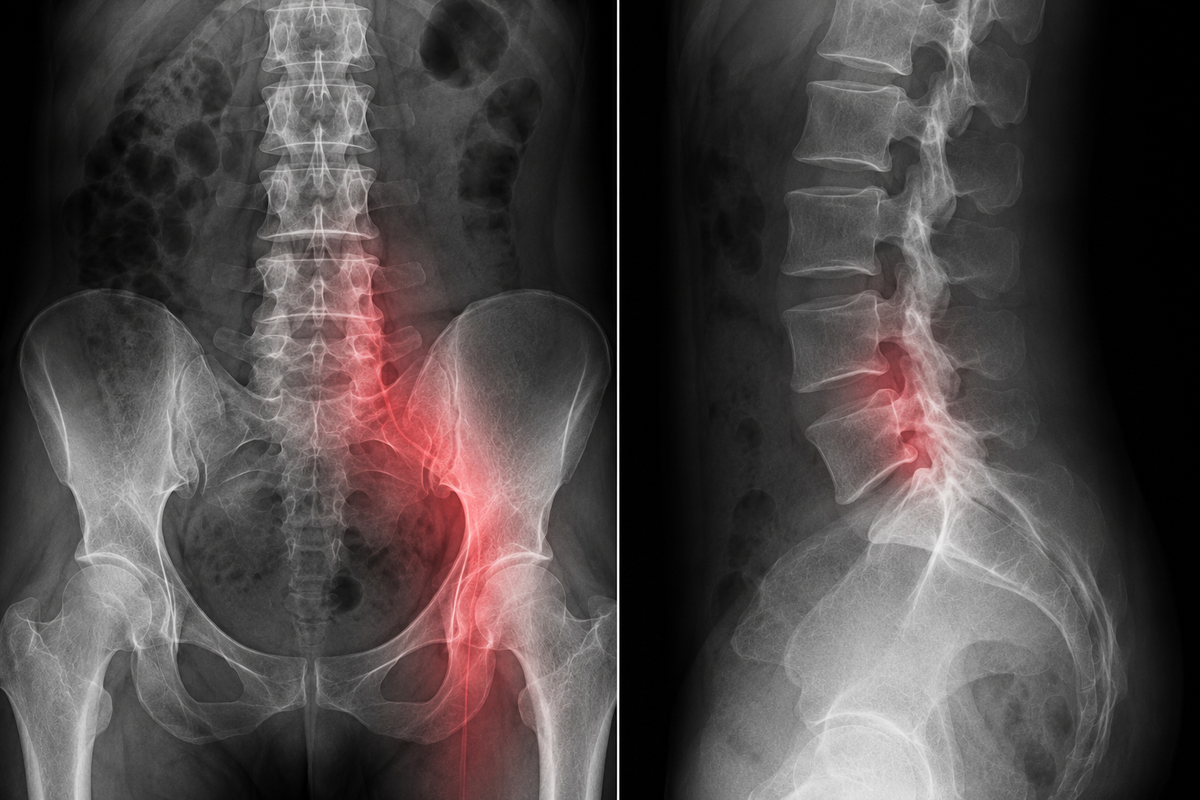
Sciatica Treatment in Los Angeles
Orthopedic Spine Surgeon — Long Beach & Torrance, CA
Medically reviewed by Brandon A. Ortega, MD · Last updated July 31, 2026
Sciatica treatment focuses on relieving irritation or compression affecting the nerves that form the sciatic nerve. Symptoms may include pain traveling from the lower back or buttock into the leg, along with numbness, tingling, or weakness. Many cases improve within several weeks through activity modification, physical therapy, medication, or injections, while persistent or progressive nerve compression may require surgery.
What Is Sciatica?
Sciatica describes nerve-related pain that follows the path of the sciatic nerve, commonly extending from the lower back or buttock into one leg. It is a symptom of an underlying condition rather than a disease by itself.
Symptoms usually develop when one or more nerve roots in the lower spine become irritated or compressed.
Understanding the Sciatic Nerve
The sciatic nerve is formed by nerve roots arising from the lower lumbar and sacral spine. It travels through the buttock and down the back of each leg, where it contributes to sensation and muscle control in the leg and foot.
Although there is a sciatic nerve on each side of the body, symptoms commonly affect only one side. The location of pain, numbness, or weakness can help identify which nerve root may be involved.
What Causes Sciatica?
Common causes include:
- Lumbar disc herniation
- Lumbar spinal stenosis
- Bone spurs associated with spinal degeneration
- Degenerative disc disease
- Spondylolisthesis
- Foraminal narrowing
- Less commonly, a spinal tumor, infection, or traumatic injury
A herniated disc is one of the most frequent causes. Disc material can extend beyond its normal position and irritate or compress a nearby nerve root, producing pain and other symptoms along the nerve’s path.
Sciatica vs. General Lower Back Pain
General lower-back pain may remain centered in the back and result from muscles, ligaments, joints, discs, or other structures. Sciatica typically includes pain that radiates into the buttock and leg because a nerve root or the sciatic nerve is irritated.
A patient can have sciatica with little lower-back pain or experience lower-back pain and sciatica at the same time. Not every pain that travels into the leg is true sciatica, so an examination may be needed to distinguish nerve compression from hip, joint, muscle, or circulation-related problems.
Symptoms of Sciatica
Sciatica symptoms can range from intermittent discomfort to severe pain that interferes with sitting, standing, walking, sleeping, or working. The pattern depends on the location and severity of nerve irritation.
Radiating Leg Pain
The most characteristic symptom is pain that travels from the lower back or buttock into the thigh, calf, foot, or toes. Patients may describe it as:
- Sharp or shooting
- Burning
- Electric
- Aching
- Stabbing
Pain may worsen with prolonged sitting, coughing, sneezing, bending, or certain movements. Symptoms commonly affect one leg rather than both.
Numbness and Tingling
Nerve irritation may cause reduced sensation, pins-and-needles, burning, or tingling in the buttock, leg, foot, or toes.
Pain and altered sensation may occur in different parts of the same leg because individual nerve fibers perform different functions.
Muscle Weakness
More significant nerve compression may weaken the muscles controlled by the affected nerve. A patient may have difficulty:
- Lifting the front of the foot
- Walking on the heels or toes
- Climbing stairs
- Rising from a chair
- Maintaining balance
- Controlling the affected leg
New or worsening weakness deserves prompt medical evaluation, particularly when it affects walking or produces foot drop.
When to Seek Urgent Care
Seek immediate emergency evaluation for sciatica accompanied by:
- New loss of bladder or bowel control
- Difficulty beginning or controlling urination
- Numbness around the groin, inner thighs, or buttocks
- Rapidly worsening leg weakness
- Severe symptoms affecting both legs
- Sudden inability to walk normally
These symptoms may indicate cauda equina syndrome, a rare but serious compression of the lower spinal nerve roots that often requires urgent treatment to reduce the risk of permanent weakness, paralysis, or incontinence.
Sciatica Treatments
Treatment depends on the underlying cause, symptom severity, neurological findings, overall health, and how the condition affects daily activity.
Most patients begin with nonsurgical care unless significant or progressive neurological impairment requires earlier intervention.
Non-Surgical Treatment
A nonsurgical treatment plan may include:
- Physical therapy
- Clinician-approved pain or anti-inflammatory medication
- Temporary activity modification
- Gentle walking and continued movement
- Heat or cold therapy
- A structured home-exercise program
- Epidural steroid or selective nerve-root injections
- Posture and movement guidance
Physical therapy may address flexibility, core strength, posture, and movement patterns that place stress on the lower spine. Prolonged bed rest is generally discouraged because inactivity can contribute to stiffness, weakness, and persistent symptoms.
An epidural steroid injection may reduce inflammation around an irritated nerve and provide temporary symptom relief. It does not repair a damaged disc or permanently reverse spinal narrowing, and the response varies between patients.
Surgical Treatment
Surgery may be considered when symptoms remain disabling despite appropriate nonsurgical care, imaging confirms a surgically treatable source of compression, or weakness and other neurological symptoms are worsening.
Depending on the cause, surgery may include:
- Microdiscectomy: Removes herniated disc material pressing on a nerve.
- Laminotomy or laminectomy: Removes a portion of bone or ligament to create more space.
- Foraminotomy: Enlarges the opening through which the nerve exits.
- Spinal fusion: May be added when nerve compression is accompanied by instability, deformity, or vertebral slippage.
Selected decompression and microdiscectomy procedures may be performed using minimally invasive techniques with tubular instruments, microscopes, or endoscopes. The surgical approach should be selected according to the condition and anatomy rather than incision size alone.
Sciatica Treatment in Los Angeles Q&A
How Is Sciatica Diagnosed?
Diagnosis generally begins with a review of the symptom pattern and a physical and neurological examination. The clinician may assess strength, sensation, reflexes, walking, and movements that reproduce leg pain.
MRI, X-rays, CT imaging, or nerve testing may be recommended when symptoms are severe, persist despite treatment, involve weakness, or require procedural planning. Imaging findings must be interpreted alongside the patient’s symptoms because not every spinal abnormality causes pain.
How Long Does Sciatica Usually Last?
Many episodes improve over several weeks, although recovery can take a few months and some symptoms may become persistent or recur.
Duration depends on the cause, severity of compression, activity level, general health, and whether neurological weakness is present.
Does Sciatica Go Away on Its Own?
It often can. Most people with sciatica caused by a herniated disc improve without surgery through time, appropriate activity, and nonsurgical treatment.
Medical evaluation is appropriate when symptoms are worsening, interfering substantially with normal activities, or not improving after several weeks.
What Can I Do to Relieve Sciatica Pain at Home?
Helpful measures may include gentle walking, avoiding prolonged bed rest, changing position regularly, and using heat or cold based on comfort.
Medication should be used only when appropriate for your medical history, and exercises should be stopped if they significantly worsen pain or neurological symptoms.
A clinician or physical therapist can recommend exercises based on the cause of the symptoms rather than using a generic routine that may not be suitable for every spinal condition.
What Is the Best Way to Sleep or Sit When I Have Sciatica?
There is no single position that works for everyone. Sleeping on the back with a pillow under the knees or on the side with a pillow between the knees may help maintain a neutral spinal position.
Some patients feel more comfortable sleeping on the side opposite the painful leg.
When sitting, use a chair with lower-back support, keep the hips and knees approximately level, and change positions regularly rather than remaining seated for extended periods.
Why Choose BAO Spine?
Fellowship-trained expertise
Advanced, subspecialty training in complex and minimally invasive spine surgery.
Conservative care first
Most patients improve without surgery — treatment begins with the least invasive options.
Motion-preserving techniques
Cervical and lumbar disc replacement that protects your natural range of motion.
Two convenient locations
Personalized spine care in both Long Beach and Torrance, California.

About Dr. Ortega
Brandon A. Ortega, MD, is a fellowship-trained orthopedic spine surgeon providing comprehensive, personalized spinal care to adults in Long Beach and Torrance, California. His dedication to helping each patient regain mobility, reduce pain, and improve their quality of life has earned the respect of everyone in the community struggling with neck and back pain.
Consultation
Get expert care for sciatica treatment in Los Angeles
Request an appointment and Brandon A. Ortega, MD's team will reach out to schedule your visit — fellowship-trained, personalized spine care.
Prefer to call? Contact us.