
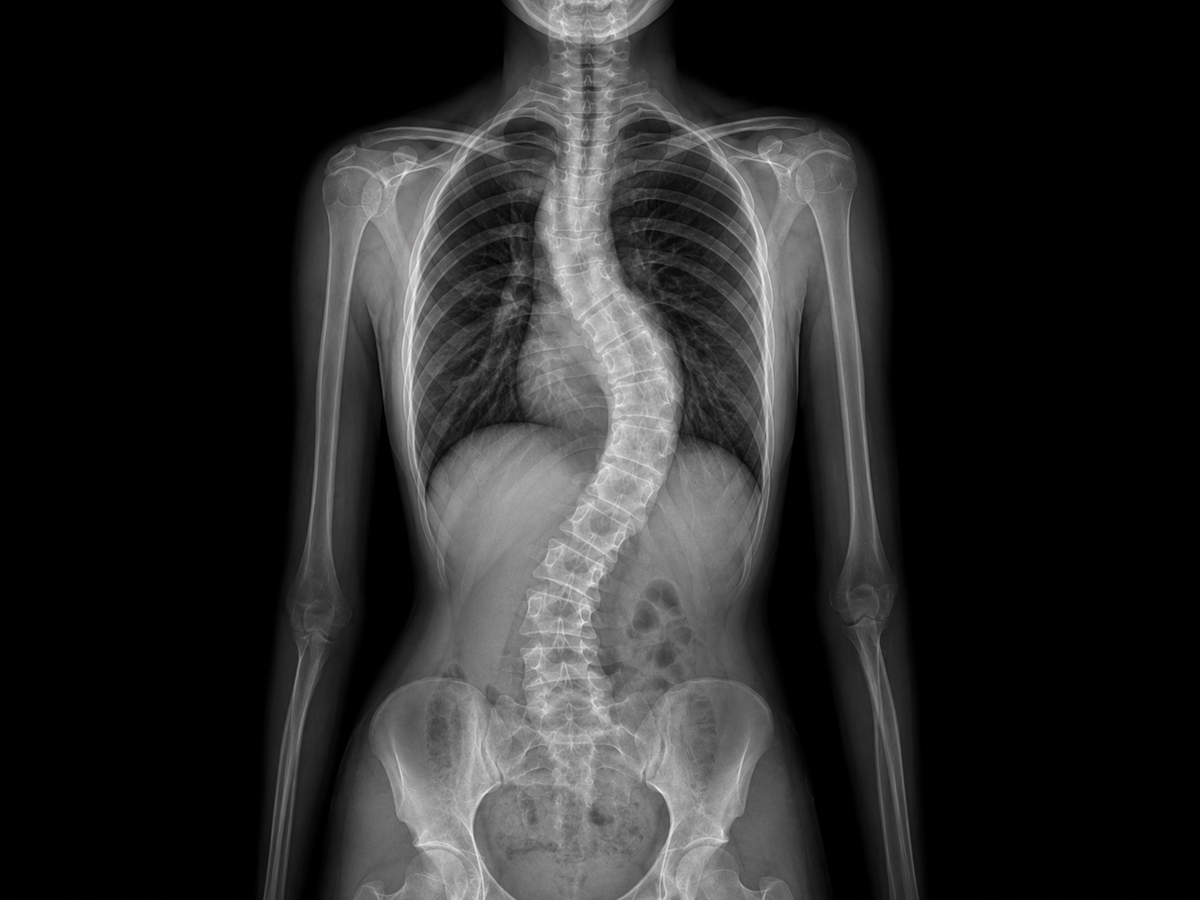
Spinal Deformity Treatment in Los Angeles
Orthopedic Spine Surgeon — Long Beach & Torrance, CA
Medically reviewed by Brandon A. Ortega, MD · Last updated August 5, 2026
Spinal deformity treatment addresses abnormal curvature, alignment, or vertebral positioning that may cause pain, posture changes, nerve compression, or difficulty standing and walking. Many patients can manage symptoms with physical therapy, medication, injections, or short-term bracing. Surgery may be considered when deformity progresses, neurological symptoms develop, or pain and imbalance substantially limit daily life.
What Are Spinal Deformities?
A spinal deformity is an abnormal change in the shape or alignment of the spine. It may involve a sideways curve, excessive forward rounding, loss of the normal lower-back curve, vertebral slippage, or a combination of these problems.
Deformities can affect the cervical, thoracic, or lumbar spine and may be present from childhood or develop later in adulthood.
Normal Alignment vs. Deformity
A healthy spine is not completely straight when viewed from the side. It has natural curves that help distribute weight, absorb force, and maintain balance. From the front or back, however, the spine should appear generally straight.
A deformity may alter alignment in one or both planes:
- Coronal deformity: Abnormal side-to-side curvature
- Sagittal deformity: Abnormal forward or backward alignment
- Rotational deformity: Twisting of the vertebrae
The severity of a deformity depends on more than the curve measurement. Overall balance, nerve compression, pain, mobility, progression, and the patient’s ability to stand upright are also important.
Types of Spinal Deformity
Common types include:
- Scoliosis: A sideways curvature that often includes rotation of the vertebrae.
- Kyphosis: Excessive forward rounding, commonly affecting the thoracic spine.
- Flatback syndrome: Loss of the normal lumbar curve, causing the patient to lean or feel pulled forward.
- Spondylolisthesis: Forward or backward slippage of one vertebra relative to another.
Some patients have more than one deformity. For example, degenerative scoliosis may occur with spinal stenosis, vertebral slippage, or loss of normal sagittal alignment.
Common Causes
Spinal deformities may be:
- Degenerative: Caused by age-related disc collapse, arthritis, weakened joints, or uneven spinal wear.
- Congenital: Related to vertebrae that formed abnormally before birth.
- Idiopathic: Developing without a clearly identifiable cause.
- Neuromuscular: Associated with conditions affecting muscle or nerve control.
- Traumatic: Resulting from fractures or other spinal injuries.
- Post-surgical: Developing after a previous decompression, fusion, or deformity operation.
Osteoporosis, vertebral compression fractures, infection, and spinal tumors may also alter alignment in some patients.
Spinal Deformity Symptoms
Symptoms vary according to the location, severity, flexibility, and cause of the deformity. Some curves cause few problems, while others affect posture, nerves, balance, or the ability to perform normal activities.
Visible Curvature or Postural Changes
Possible physical changes include:
- Uneven shoulders or hips
- One shoulder blade appearing more prominent
- Leaning toward one side
- A rounded upper back
- A forward-pitched posture
- Difficulty standing fully upright
- An uneven waistline
- Changes in how clothing fits
Flatback or sagittal imbalance may cause a persistent feeling of falling forward. Patients may compensate by bending their knees or hips to remain upright, which can increase fatigue and discomfort.
Back Pain and Stiffness
Spinal deformity may place uneven stress on discs, joints, muscles, and ligaments. This can cause:
- Neck, middle-back, or lower-back pain
- Muscle fatigue or spasms
- Stiffness
- Pain after prolonged standing or walking
- Difficulty maintaining an upright posture
- Reduced spinal flexibility
Pain severity does not always correspond directly with the curve’s size. Smaller deformities may be painful when accompanied by arthritis or nerve compression, while some larger curves produce limited symptoms.
Radiating Pain, Numbness, or Weakness
Degeneration and altered alignment can narrow the spinal canal or the openings through which nerves exit.
Nerve-related symptoms may include:
- Pain traveling into an arm or leg
- Numbness or tingling
- Leg heaviness or cramping
- Reduced grip or leg strength
- Foot drop
- Difficulty walking
Spinal-cord compression in the cervical or thoracic spine may also cause hand clumsiness, balance problems, leg stiffness, or loss of coordination.
Loss of Height, Balance, or Mobility
Disc collapse, vertebral fractures, and progressive curvature may cause measurable height loss. Patients may also notice:
- Reduced walking distance
- Difficulty looking straight ahead
- Increasing dependence on a cane or walker
- Frequent rest breaks
- Problems with balance
- Difficulty performing household or work activities
Prompt evaluation is appropriate for progressive weakness, frequent falls, increasing hand clumsiness, or rapidly declining mobility. New bladder or bowel dysfunction or numbness around the groin requires emergency medical care.
Spinal Deformity Treatments
Treatment is based on the type of deformity, symptom severity, neurological findings, curve progression, bone quality, general health, and effect on daily function.
The goal is not always to make the spine appear completely straight. Treatment may instead focus on controlling pain, maintaining balance, protecting neurological function, and improving quality of life.
Non-Surgical Treatment
Many patients begin with nonsurgical care, which may include:
- Physical therapy
- Posture and balance training
- Core and back strengthening
- Clinician-approved medication
- Activity modification
- Weight management
- Epidural or selective nerve-root injections
- Facet-joint injections
- Short-term bracing in selected cases
- Osteoporosis evaluation and treatment
Physical therapy may improve strength, endurance, posture, flexibility, and movement mechanics. Injections may reduce inflammation associated with nerve or joint irritation but do not correct the spinal curve itself.
Bracing is more commonly used to control curve progression in growing children and adolescents. In adults, a brace may sometimes provide short-term support or symptom relief, but it generally does not permanently correct a fixed deformity.
Surgical Treatment
Surgery may be considered when:
- Pain remains disabling despite appropriate nonsurgical care
- The deformity is progressing
- The patient cannot stand upright or maintain balance
- Nerve or spinal-cord compression causes neurological symptoms
- Walking and daily function continue to decline
- Significant instability is present
- The deformity affects breathing or other organ function
- Previous spinal reconstruction has failed
Depending on the condition, surgery may involve:
- Spinal decompression: Removes bone, ligament, or disc material pressing on nerves.
- Spinal fusion: Joins vertebrae to stabilize the spine and maintain corrected alignment.
- Instrumentation: Uses screws and rods to support the correction while fusion develops.
- Interbody fusion: Restores disc height and alignment using cages placed between vertebrae.
- Osteotomy: Removes or reshapes bone to correct a rigid deformity.
- Revision reconstruction: Repairs a failed fusion, imbalance, or hardware-related problem.
Decompression alone may be appropriate for selected nerve-compression problems, but fusion is commonly required when the deformity includes instability or when decompression could worsen alignment. Adult deformity correction can be extensive, and the expected functional benefit must be weighed carefully against the risks and recovery involved.
Common Types of Spinal Deformity
Scoliosis
Scoliosis is a sideways spinal curve that typically includes rotation of the vertebrae. In adults, it may be a continuation of adolescent scoliosis or develop later because of uneven disc and joint degeneration.
Treatment depends on pain, progression, neurological symptoms, balance, and functional limitations rather than curve size alone. Many adults are treated nonsurgically, while severe symptomatic deformity may require decompression and fusion.
Kyphosis
Kyphosis is excessive forward curvature of the spine, commonly creating a rounded or hunched posture. It may result from congenital development, growth-related conditions, degeneration, osteoporosis-related fractures, trauma, or previous surgery.
Mild cases may cause few problems. More advanced kyphosis can produce pain, stiffness, balance difficulty, nerve compression, or reduced ability to look forward.
Spondylolisthesis
Spondylolisthesis occurs when one vertebra slips relative to the vertebra below it. It can result from degeneration, a stress fracture, congenital anatomy, trauma, or previous surgery.
Symptoms may include lower-back pain, leg pain, weakness, and difficulty standing or walking. Many low-grade cases improve with nonsurgical treatment, while decompression and fusion may be considered for persistent symptoms, instability, or significant nerve compression.
Spinal Deformity Treatment in Los Angeles Q&A
What Are the Most Common Types of Spinal Deformity?
Common deformities include scoliosis, kyphosis, flatback syndrome, and spondylolisthesis. Some patients have combined deformities involving both sideways curvature and abnormal forward or backward alignment.
What Causes Spinal Deformities in Adults?
Adult deformities commonly result from disc degeneration, arthritis, osteoporosis-related fractures, progression of a childhood curve, trauma, or previous spinal surgery. Some congenital or idiopathic deformities remain present into adulthood.
What Are the Symptoms of a Spinal Deformity?
Symptoms may include visible curvature, uneven shoulders or hips, back pain, stiffness, forward-leaning posture, reduced height, difficulty walking, and fatigue when standing. Nerve compression may cause radiating pain, numbness, tingling, or weakness.
Can Spinal Deformities Be Treated Without Surgery?
Yes. Physical therapy, posture training, medication, injections, activity changes, weight management, and short-term bracing may reduce symptoms and improve function. Nonsurgical care generally does not fully correct a fixed adult deformity, but many patients can manage their condition without surgery.
When Is Surgery Necessary for a Spinal Deformity?
urgery may be considered when severe pain or imbalance persists despite nonsurgical treatment, the deformity continues to progress, neurological function worsens, or the patient’s ability to stand, walk, or perform daily activities becomes substantially limited.
The recommendation should consider the anticipated benefit, surgical complexity, bone quality, general health, and recovery requirements.
Why Choose BAO Spine?
Fellowship-trained expertise
Advanced, subspecialty training in complex and minimally invasive spine surgery.
Conservative care first
Most patients improve without surgery — treatment begins with the least invasive options.
Motion-preserving techniques
Cervical and lumbar disc replacement that protects your natural range of motion.
Two convenient locations
Personalized spine care in both Long Beach and Torrance, California.

About Dr. Ortega
Brandon A. Ortega, MD, is a fellowship-trained orthopedic spine surgeon providing comprehensive, personalized spinal care to adults in Long Beach and Torrance, California. His dedication to helping each patient regain mobility, reduce pain, and improve their quality of life has earned the respect of everyone in the community struggling with neck and back pain.
Consultation
Get expert care for spinal deformity treatment in Los Angeles
Request an appointment and Brandon A. Ortega, MD's team will reach out to schedule your visit — fellowship-trained, personalized spine care.
Prefer to call? Contact us.