
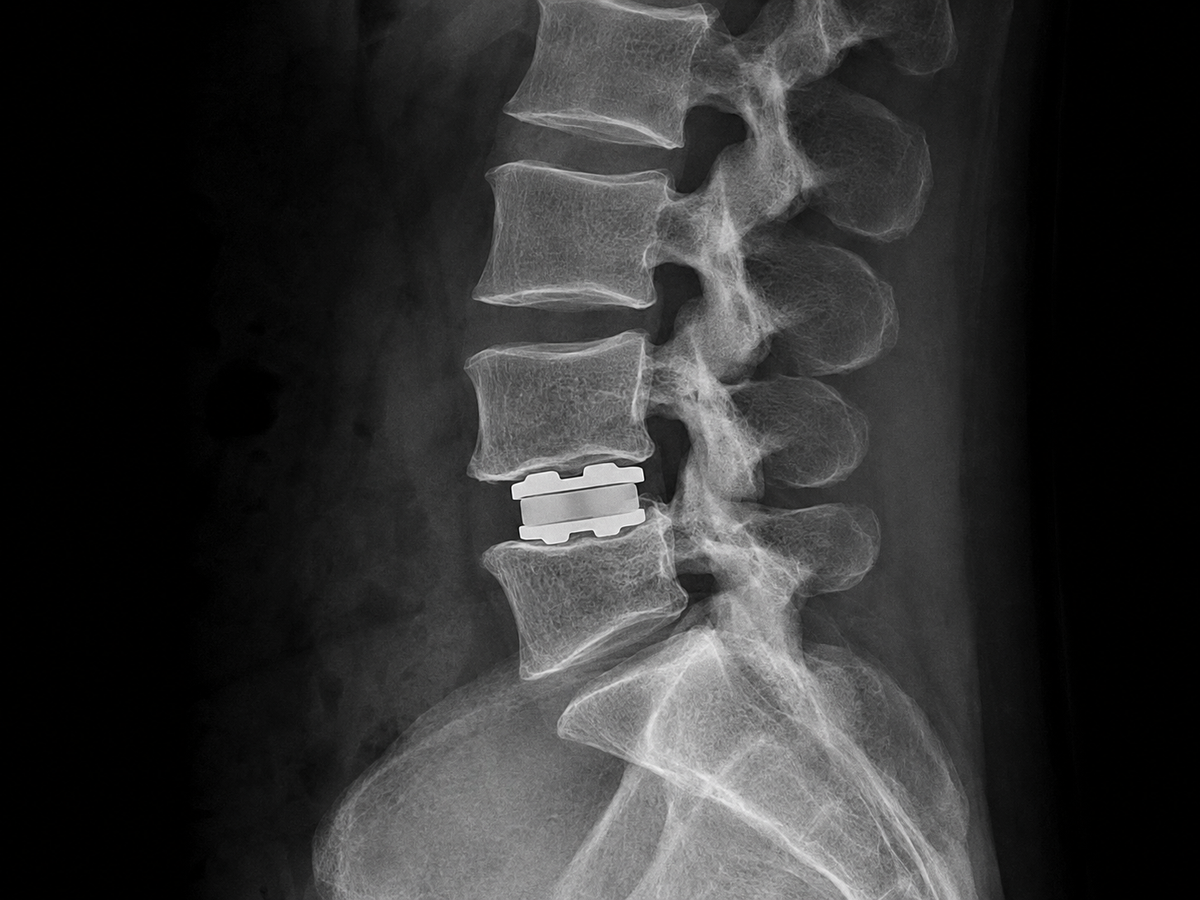
Lumbar Disc Replacement in Los Angeles
Orthopedic Spine Surgeon — Long Beach & Torrance, CA
Medically reviewed by Brandon A. Ortega, MD · Last updated August 5, 2026
Lumbar disc replacement removes a damaged lower-back disc and replaces it with an artificial implant designed to preserve movement at the treated level. Most patients begin walking shortly after surgery and gradually resume normal activities over several weeks, with broader recovery commonly occurring by about three months. Reduced disc-related back pain, improved function, maintained spinal motion, and stable implant positioning are common indicators of success.
What Is a Lumbar Disc Replacement?
Lumbar disc replacement, also called lumbar disc arthroplasty or total disc replacement, is a motion-preserving alternative to spinal fusion for carefully selected patients.
During the procedure, the damaged disc is removed through an incision in the front of the abdomen. The artificial disc is then positioned between the adjacent vertebrae to restore disc height, support the spinal segment, and allow continued movement. A vascular or abdominal access surgeon may assist because major blood vessels and abdominal structures lie in front of the lumbar spine.
Unlike fusion, disc replacement does not intentionally join the vertebrae together. However, it cannot guarantee normal motion or complete pain relief.
FDA-approved indications depend on the specific implant. Some lumbar devices are approved for one level, while others may be used at one or two adjacent levels between L3 and S1 in qualifying patients.
Conditions Treated
Lumbar disc replacement may be considered for:
- Lumbar degenerative disc disease
- Chronic discogenic lower-back pain
- Loss of lumbar disc height
- Single-level disc degeneration
- Selected two-level disc degeneration
- Limited vertebral slippage associated with disc degeneration
Discogenic pain refers to pain believed to originate from a damaged spinal disc. It is commonly centered in the lower back and may worsen with sitting, bending, lifting, or other activities that load the disc.
Not every patient with multilevel degeneration is eligible for replacement. The number and location of levels that can be treated depend on the implant’s approved indications, the condition of the facet joints, spinal alignment, and whether each damaged disc is contributing to the symptoms.
Surgery Candidates and General Patient Criteria
Lumbar disc replacement has relatively narrow eligibility requirements. Potential candidates may have:
- Persistent disc-related lower-back pain
- Disc degeneration confirmed through examination and imaging
- Symptoms corresponding with one or two specific lumbar levels
- At least six months of appropriate nonsurgical treatment without sufficient improvement
- Preserved movement at the proposed treatment level
- Adequate bone quality
- Little or no advanced facet-joint arthritis
- No more than limited vertebral slippage
- General health suitable for abdominal surgery and anesthesia
- Skeletal maturity
FDA labeling for approved lumbar artificial discs generally requires symptomatic degenerative disc disease and unsuccessful nonsurgical treatment before implantation. Exact eligibility varies by device.
Disc replacement may not be suitable for patients with severe osteoporosis, advanced facet arthritis, significant instability, major spinal deformity, infection, fracture, extensive spinal stenosis, or degeneration outside the implant’s approved levels.
The presence of degeneration on MRI does not establish that the disc is causing pain. The surgeon must compare the patient’s symptoms, examination findings, spinal alignment, and imaging before recommending replacement.
What to Expect
Before Surgery
Preparation may include:
- Physical and neurological examination
- Standing X-rays and lumbar MRI
- CT imaging when additional bone detail is needed
- Bone-density testing
- Medical and anesthesia clearance
- Medication and supplement review
- Instructions concerning blood-thinning medications
- Fasting before surgery
- Arranging transportation and assistance at home
Previous abdominal surgery, vascular disease, osteoporosis, nicotine use, and allergy or sensitivity to implant materials should be discussed during the evaluation.
During Surgery
Lumbar disc replacement is usually performed under general anesthesia through an anterior abdominal approach.
The surgical team generally:
- Makes an incision in the lower abdomen.
- Carefully moves abdominal tissues and major blood vessels aside.
- Confirms the correct spinal level using X-ray imaging.
- Removes the damaged disc.
- Prepares the adjacent vertebral surfaces.
- Inserts the appropriately sized artificial disc.
- Confirms implant position and spinal alignment.
- Closes the incision.
Surgery often takes approximately one to two hours per treated level, although the duration varies with anatomy, the number of levels, and surgical complexity.
Recovery and Rehabilitation
Most patients begin walking on the day of surgery. Some may go home the same day, although an overnight hospital stay is common. Basic activities such as sitting, standing, walking, and bathing may resume early, according to the surgical team’s instructions.
Recovery guidance may include:
- Taking short, frequent walks
- Keeping the incision clean and dry
- Avoiding heavy lifting
- Limiting repetitive bending and twisting
- Avoiding running and high-impact exercise initially
- Taking medication as directed
- Attending follow-up appointments and imaging
- Beginning physical therapy when recommended
Physical therapy may focus on walking tolerance, core strength, flexibility, posture, and safe movement mechanics.
Rigorous activity is generally restricted during the initial healing period. HSS notes that patients may often return to normal activities by approximately three months, although recovery varies according to the number of levels treated, occupation, health, and response to surgery.
Potential Complications and Success Indicators
Potential complications include:
- Infection
- Bleeding or blood clots
- Reaction to anesthesia
- Injury to major blood vessels
- Injury to abdominal structures
- Nerve damage
- Retrograde ejaculation in male patients
- Persistent or recurrent pain
- Implant migration or incorrect positioning
- Implant settling into the vertebral bone
- Implant wear or mechanical failure
- Bone formation that restricts implant movement
- Degeneration of the facet joints
- Need for revision surgery or spinal fusion
Disc replacement has implant-specific risks that differ from fusion. Careful patient selection, accurate sizing, and proper implant positioning are therefore important.
Common indicators of a successful outcome include:
- Reduced disc-related lower-back pain
- Improved sitting, standing, and walking tolerance
- Improved ability to work or perform daily activities
- Maintained movement at the treated level
- Stable implant position on follow-up imaging
- No worsening neurological symptoms
Disc replacement may effectively treat selected cases of discogenic back pain, but results for generalized lower-back pain are less predictable than results for clearly identified nerve compression.
Lumbar Disc Replacement in Los Angeles Q&A
How Is Lumbar Disc Replacement Different From Fusion?
Disc replacement uses a mobile implant intended to preserve movement at the treated level. Fusion permanently joins the adjacent vertebrae. Fusion may be more appropriate when substantial instability, deformity, poor bone quality, or advanced facet arthritis is present.
Can Two Lumbar Discs Be Replaced?
Certain FDA-approved devices may be used at two adjacent levels from L3 to S1 in qualifying patients. Other devices are approved only for one level. Eligibility depends on the implant, anatomy, bone quality, and location of the degeneration.
How Long Does Recovery Take?
Walking and basic daily activities often begin immediately after surgery. More demanding activities are introduced gradually, and many patients return to normal activities around three months. Individual recovery may be shorter or longer.
Why Choose BAO Spine?
Fellowship-trained expertise
Advanced, subspecialty training in complex and minimally invasive spine surgery.
Conservative care first
Most patients improve without surgery — treatment begins with the least invasive options.
Motion-preserving techniques
Cervical and lumbar disc replacement that protects your natural range of motion.
Two convenient locations
Personalized spine care in both Long Beach and Torrance, California.

About Dr. Ortega
Brandon A. Ortega, MD, is a fellowship-trained orthopedic spine surgeon providing comprehensive, personalized spinal care to adults in Long Beach and Torrance, California. His dedication to helping each patient regain mobility, reduce pain, and improve their quality of life has earned the respect of everyone in the community struggling with neck and back pain.
Consultation
Get expert care with lumbar disc replacement in Los Angeles
Request an appointment and Brandon A. Ortega, MD's team will reach out to schedule your visit — fellowship-trained, personalized spine care.
Prefer to call? Contact us.