
Cervical Radiculopathy Treatment in Los Angeles
Orthopedic Spine Surgeon — Long Beach & Torrance, CA
Medically reviewed by Brandon A. Ortega, MD · Last updated August 1, 2026
Cervical radiculopathy occurs when a nerve root in the neck becomes compressed, irritated, or inflamed. The condition can cause pain that travels from the neck into the shoulder, arm, or hand, along with numbness, tingling, burning sensations, or muscle weakness. At BAO Spine, patients receive individualized evaluation and treatment for cervical radiculopathy and other conditions affecting the cervical spine. Depending on the source and severity of nerve compression, treatment may include physical therapy, medication, cervical spinal injections, or surgery to create more room for the affected nerve. The appropriate treatment depends on which nerve root is involved, what is causing the compression, how long symptoms have been present, whether muscle weakness is developing, and how significantly the condition affects work, sleep, and everyday activities.
What Is Cervical Radiculopathy?
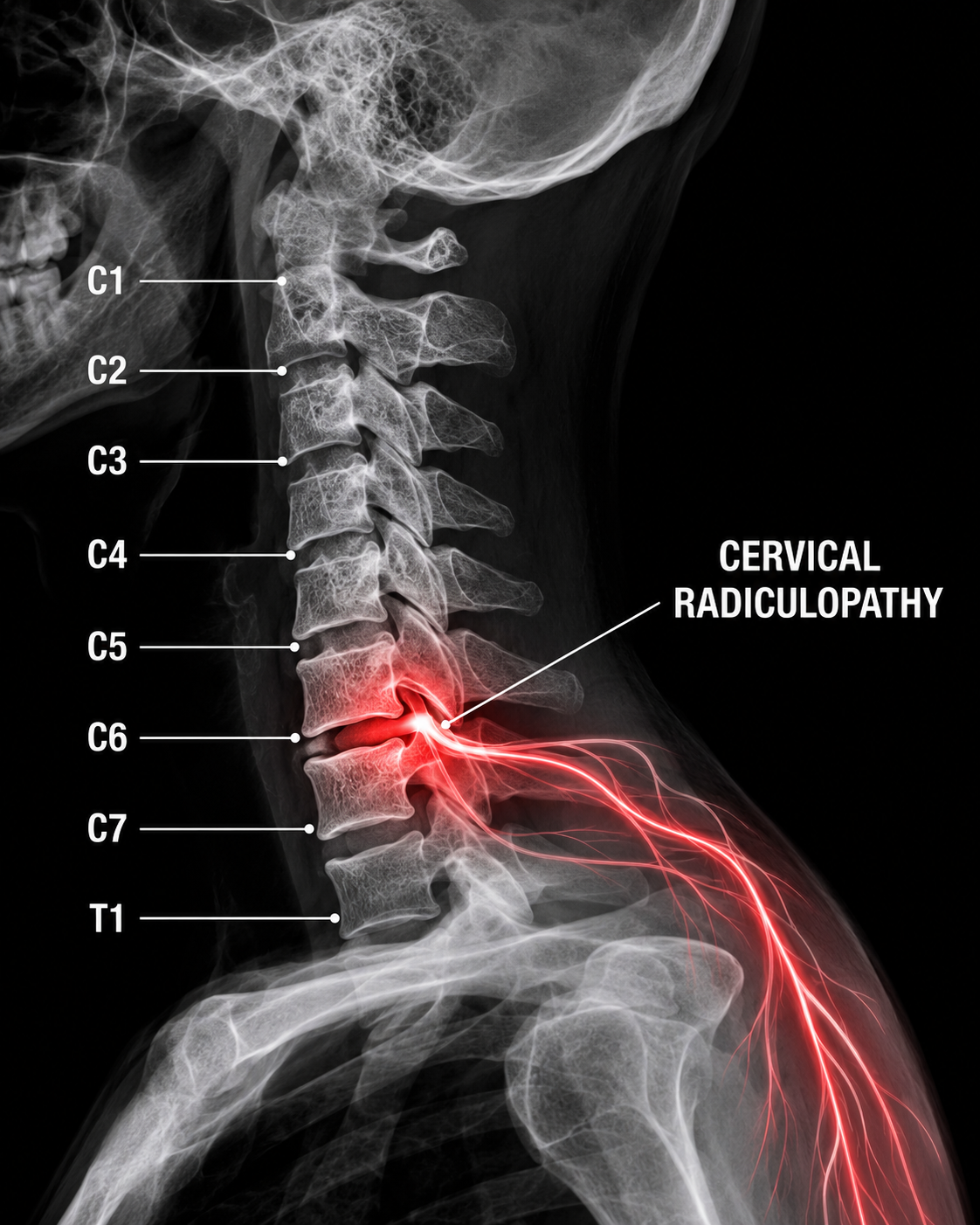
Cervical radiculopathy is a neurological condition involving one or more nerve roots in the cervical spine. The cervical spine consists of seven vertebrae, labeled C1 through C7, that form the neck and protect the upper portion of the spinal cord.
Eight pairs of cervical nerves branch from the spinal cord and carry signals to and from the shoulders, arms, hands, and fingers. When one of these nerve roots becomes compressed or inflamed, symptoms may develop along the pathway of the affected nerve.
Cervical radiculopathy is commonly described as a pinched nerve in the neck. Unlike pain that remains localized to strained muscles or spinal joints, radicular symptoms generally extend away from the neck and into the upper extremity.
How a Cervical Nerve Root Gets Pinched
Cervical nerve roots leave the spinal canal through openings between adjacent vertebrae called neural foramina. A nerve root may become compressed when a disc, bone spur, enlarged joint, or other tissue reduces the available space within one of these openings.
A herniated cervical disc can press directly against a nearby nerve root. Age-related degeneration can also cause discs to lose height, bringing the vertebrae closer together and narrowing the neural foramina.
The body may respond to disc degeneration by producing bone spurs. These additional areas of bone can extend into the foramen and place pressure on the exiting nerve.
Symptoms may result from both mechanical pressure and inflammation. Material released by a damaged disc can irritate the nerve root even when the degree of visible compression is relatively limited.
Neck position may also affect the available space around the nerve. Extending the neck or turning the head toward the symptomatic side may temporarily narrow the foramen and intensify arm pain in some patients.
Common Causes of Cervical Radiculopathy
Several cervical spine conditions can cause nerve-root compression.
Cervical disc herniation: The soft inner material of a cervical disc may push through a weakened area in the disc’s outer layer and press against a nerve root. Herniated discs are a common cause of cervical radiculopathy in younger and middle-aged adults.
Cervical degenerative disc disease: Spinal discs naturally lose water content, height, and flexibility over time. As the disc space becomes smaller, the openings available for the cervical nerves may narrow.
Cervical spondylosis: Age-related arthritis can affect the discs, uncovertebral joints, and facet joints of the neck. These changes may cause bone spurs and foraminal narrowing.
Cervical foraminal stenosis: Foraminal stenosis specifically refers to narrowing of the opening through which a cervical nerve exits the spine.
Bone spurs: Additional bone growth associated with arthritis may extend into the neural foramen and compress a nerve root.
Spinal instability or spondylolisthesis: Abnormal movement or slippage between cervical vertebrae may alter alignment and reduce the space available for the nerves.
Neck injuries: A collision, fall, sports injury, or other trauma may cause a disc herniation, fracture, swelling, or instability that affects a cervical nerve.
Less commonly, cervical nerve compression may be associated with a cyst, infection, or spinal tumor. Identifying the underlying cause is important because treatment recommendations vary between these conditions.
Commonly Affected Levels
Cervical radiculopathy most often affects the lower cervical spine, particularly the C5-C6 and C6-C7 disc levels.
A problem at a particular disc level generally affects the nerve root that exits below the upper vertebra. For example, a disc herniation at C5-C6 commonly affects the C6 nerve root, while a C6-C7 disc problem commonly affects the C7 nerve root.
Common patterns include:
C5 nerve-root compression may cause pain around the neck, shoulder, and upper arm. Weakness may affect the deltoid or biceps muscles.
C6 nerve-root compression may cause pain or altered sensation that extends through the outer forearm toward the thumb. Weakness may affect the biceps or wrist-extensor muscles.
C7 nerve-root compression may cause pain that travels through the back of the arm toward the middle finger. Weakness may affect the triceps, wrist, or finger-extensor muscles.
C8 nerve-root compression may affect the inner forearm, ring finger, or little finger. It can also contribute to weakness in the hand and finger-flexor muscles.
These patterns are useful diagnostic clues, but symptoms do not always follow a perfect anatomical map. More than one nerve may be affected, and conditions such as carpal tunnel syndrome, cubital tunnel syndrome, shoulder disease, or peripheral neuropathy can produce similar symptoms.
Cervical Radiculopathy Symptoms
Cervical radiculopathy symptoms depend on which nerve root is affected and how severely it is irritated or compressed.
Symptoms most commonly affect one side of the body, although a large central disc herniation or multilevel degenerative condition may affect both arms. Pain may be constant or intermittent and can worsen with certain neck positions.
Pain Radiating From the Neck Into the Shoulder and Arm
The most recognizable symptom is pain that begins in the neck or shoulder-blade region and travels into the shoulder, arm, forearm, or hand.
The pain may feel:
- Sharp
- Shooting
- Burning
- Aching
- Electric
- Similar to a sudden shock
Turning the head, looking upward, extending the neck, coughing, or sneezing may aggravate symptoms. Some patients experience temporary relief when they rest the affected hand on top of the head because this position may reduce tension on the nerve root.
The location of the pain can provide information about which cervical nerve is affected. However, some patients have significant arm pain with relatively little neck discomfort.
Numbness and Tingling in the Arm or Hand
Compression of a cervical nerve may interfere with sensory signals traveling between the upper extremity and the spinal cord.
Patients may experience:
- Numbness
- Tingling
- Pins-and-needles sensations
- Burning discomfort
- Reduced sensitivity to touch
- Unusual sensitivity in the skin
Symptoms may affect part of the shoulder, upper arm, forearm, hand, or individual fingers. For example, C6 nerve irritation may affect the thumb side of the hand, while C7 symptoms may extend toward the middle finger.
The location of numbness and tingling can help identify the involved nerve root, but testing may be necessary to distinguish cervical radiculopathy from compression of a peripheral nerve at the elbow or wrist.
Muscle Weakness and Grip Changes
Cervical nerve roots also control muscles in the shoulders, arms, wrists, hands, and fingers. Significant or prolonged compression may interfere with these motor signals and cause weakness.
Possible signs include:
- Difficulty lifting the arm
- Weakness when bending or straightening the elbow
- Difficulty extending the wrist
- Reduced grip strength
- Trouble opening jars
- Frequently dropping objects
- Difficulty pushing, pulling, or lifting
- Reduced dexterity during fine hand movements
Weakness affecting a specific muscle group can help determine which cervical nerve root is involved. Grip changes may also occur with carpal tunnel syndrome, ulnar nerve compression, arthritis, or other conditions, so a neurological examination is important.
New or worsening weakness should be evaluated promptly. Continued nerve compression can sometimes result in lasting muscle weakness or loss of muscle mass.
Red-Flag Symptoms
Cervical radiculopathy affects an individual nerve root. However, some neck conditions can also compress the spinal cord, producing a more serious condition called cervical myelopathy.
Seek prompt or emergency medical evaluation for:
- Rapidly worsening arm or hand weakness
- Symptoms affecting both arms
- New leg weakness or heaviness
- Difficulty walking or maintaining balance
- Frequent stumbling or unexplained falls
- Loss of hand coordination or fine motor control
- Difficulty fastening buttons or writing
- New bowel or bladder dysfunction
- Numbness affecting multiple limbs
- Severe symptoms following a fall, collision, or neck injury
- Neck pain accompanied by fever or chills
- Persistent pain with unexplained weight loss
- Neck pain in a patient with a history of cancer or immunosuppression
Balance problems, hand clumsiness, abnormal reflexes, and leg symptoms may indicate pressure on the spinal cord rather than compression of only one nerve root. Prompt evaluation is important because cervical spinal cord dysfunction can progress and may cause permanent neurological impairment.
Cervical Radiculopathy Treatments
Evaluation begins with a discussion of the patient’s symptoms, medical history, previous treatment, and activity limitations.
A physical and neurological examination may assess neck movement, muscle strength, sensation, reflexes, coordination, and whether specific positions reproduce the arm symptoms. The examination may also look for evidence of shoulder disease, carpal tunnel syndrome, ulnar nerve compression, or cervical spinal cord dysfunction.
X-rays can show cervical alignment, arthritis, disc-space narrowing, instability, or bone spurs. An MRI provides detailed images of the discs, nerve roots, spinal canal, and spinal cord.
A CT scan may provide additional detail about bone spurs or foraminal narrowing. Electromyography and nerve-conduction studies may be used when the diagnosis is unclear or when symptoms could be coming from a nerve problem outside the cervical spine.
Non-Surgical Treatment
Most patients with cervical radiculopathy begin with nonsurgical treatment, provided they do not have progressive weakness, spinal cord dysfunction, or another condition requiring urgent intervention.
Nonsurgical treatment may include:
Activity modification: Temporarily reducing heavy lifting, overhead work, repetitive neck movement, or prolonged positions that aggravate symptoms may allow nerve irritation to decrease.
Physical therapy: A structured rehabilitation program may include exercises to improve neck strength, posture, flexibility, shoulder mechanics, and range of motion. Gentle cervical traction may be appropriate for selected patients.
Medication: Anti-inflammatory medication, pain relievers, a short course of oral corticosteroids, muscle relaxants, or medication used for nerve pain may be considered based on the patient’s symptoms and medical history.
Short-term cervical collar use: A soft collar may temporarily limit painful neck movement and allow irritated muscles or nerve roots to rest. Prolonged use is generally avoided because it may weaken the supporting neck muscles.
Cervical epidural steroid injections: Corticosteroid medication may be placed near an inflamed cervical nerve root to reduce swelling and radiating arm pain.
Selective nerve-root injections: A targeted injection may provide temporary relief and help identify the symptomatic nerve when imaging shows abnormalities at more than one cervical level.
Ergonomic and postural changes: Workstation adjustments, improved screen positioning, appropriate lifting techniques, and avoiding prolonged forward-head posture may reduce stress on the cervical spine.
Spinal injections do not remove a herniated disc or bone spur. However, reducing inflammation may provide enough relief for the nerve to recover and for the patient to participate more effectively in physical therapy.
Many cases improve over time without surgery. The duration of conservative treatment depends on symptom severity, the underlying cause, neurological findings, and the patient’s progress.
Surgical Treatment
Surgery may be considered when arm pain, numbness, or weakness persists or worsens despite an appropriate course of nonsurgical treatment.
Earlier surgical evaluation may be appropriate for progressive muscle weakness, severe nerve compression, cervical spinal instability, or signs that the spinal cord is also being affected.
The primary goal of surgery is to remove the disc material, bone spur, or other tissue placing pressure on the affected nerve. The procedure selected depends on the location of the compression, the number of involved levels, cervical alignment, spinal stability, and whether motion preservation is appropriate.
Anterior cervical discectomy and fusion: Anterior cervical discectomy and fusion, commonly called ACDF, approaches the cervical spine from the front of the neck. The damaged disc and any compressive bone spurs are removed to create more room for the nerve.
A bone graft or spacer is then placed between the vertebrae to restore disc height and stabilize the treated level. A plate and screws may also be used.
ACDF may be considered when cervical radiculopathy results from disc herniation, degenerative disc disease, foraminal stenosis, or a combination of disc and bone compression.
Cervical disc replacement: Cervical disc replacement removes the damaged disc and replaces it with an artificial disc implant.
Like ACDF, the procedure decompresses the affected nerve through an anterior approach. Unlike fusion, disc replacement is designed to preserve motion at the treated spinal level.
Cervical disc replacement may be appropriate for selected patients with one- or two-level disc disease who do not have significant instability, severe facet-joint degeneration, osteoporosis, or another condition that makes motion preservation unsuitable.
Posterior cervical foraminotomy: A posterior cervical foraminotomy approaches the nerve from the back of the neck. A portion of bone or soft tissue is removed to enlarge the neural foramen and relieve pressure on the nerve root.
This procedure may preserve motion because it does not always require fusion. It can be considered when the compression is located toward the side of the spinal canal and can be safely reached through a posterior approach.
Posterior cervical decompression: Procedures such as laminotomy, laminectomy, or laminoplasty create additional room within the spinal canal. These operations are more commonly associated with central stenosis or spinal cord compression but may be incorporated into treatment when nerve-root compression occurs as part of a broader cervical condition.
Cervical spinal fusion: Fusion may be performed when the cervical spine is unstable, when decompression would create instability, or when the patient has deformity, significant degeneration, or slippage between vertebrae.
Some cervical procedures may be performed using minimally invasive techniques. However, the safest approach depends on the location and complexity of the compression rather than incision size alone.
At BAO Spine, the surgical plan is based on the affected nerve root, imaging findings, neurological examination, cervical alignment, spinal stability, and the patient’s individual goals.
Cervical Radiculopathy Treatment in Los Angeles Q&A
What Is Cervical Radiculopathy?
Cervical radiculopathy is compression, irritation, or inflammation of a nerve root in the neck. It may cause pain that travels into the shoulder, arm, or hand, along with numbness, tingling, weakness, or changes in reflexes.
The condition is commonly called a pinched nerve in the neck.
What Causes a Pinched Nerve in the Neck?
Common causes include a cervical herniated disc, degenerative disc disease, cervical spondylosis, bone spurs, and foraminal stenosis.
These conditions may narrow the opening through which a cervical nerve exits the spine. Less commonly, nerve compression may result from an injury, spinal instability, cyst, infection, or tumor.
What Are the Symptoms of Cervical Radiculopathy?
Symptoms may include pain that travels from the neck into the shoulder, arm, forearm, hand, or fingers. Patients may also experience numbness, tingling, burning sensations, muscle weakness, reduced grip strength, or changes in reflexes.
The precise symptom pattern depends on which cervical nerve root is affected.
Can Cervical Radiculopathy Heal Without Surgery?
Yes. Many patients improve with time and nonsurgical care, including activity modification, physical therapy, medication, and, when appropriate, cervical spinal injections.
Symptoms associated with an acute disc herniation may improve as inflammation decreases and the herniated material changes over time. Degenerative narrowing cannot always be reversed, but symptoms may still improve without surgery.
Nonsurgical care may not be appropriate when the condition causes progressive weakness, spinal cord dysfunction, or another serious neurological problem.
How Is Cervical Radiculopathy Diagnosed?
Diagnosis begins with a review of the patient’s symptoms and a physical examination of the neck, shoulders, arms, and hands. The examination may assess muscle strength, sensation, reflexes, neck range of motion, grip strength, hand coordination, and positions that reproduce or relieve symptoms. A Spurling test may also be used to determine whether extending and turning the neck triggers arm symptoms. X-rays can identify alignment problems, disc-space narrowing, arthritis, or bone spurs, while MRI is commonly used to visualize the cervical discs, nerve roots, and spinal cord. CT imaging may provide additional detail about bony narrowing, and electromyography and nerve-conduction studies can help distinguish cervical radiculopathy from peripheral nerve conditions such as carpal tunnel syndrome or ulnar nerve compression.
When Is Surgery Necessary for a Pinched Nerve in the Neck?
Surgery may be considered when severe arm pain, numbness, or weakness continues despite an appropriate course of nonsurgical care.
Earlier surgery may be recommended when the patient develops progressive muscle weakness, significant loss of function, severe nerve compression, cervical instability, or signs of spinal cord involvement.
Possible procedures include ACDF, cervical disc replacement, and posterior cervical foraminotomy. The appropriate operation depends on the location and cause of the compression, the number of affected levels, spinal alignment, and whether the treated segment is stable.
Why Choose BAO Spine?
Fellowship-trained expertise
Advanced, subspecialty training in complex and minimally invasive spine surgery.
Conservative care first
Most patients improve without surgery — treatment begins with the least invasive options.
Motion-preserving techniques
Cervical and lumbar disc replacement that protects your natural range of motion.
Two convenient locations
Personalized spine care in both Long Beach and Torrance, California.

About Dr. Ortega
Brandon A. Ortega, MD, is a fellowship-trained orthopedic spine surgeon providing comprehensive, personalized spinal care to adults in Long Beach and Torrance, California. His dedication to helping each patient regain mobility, reduce pain, and improve their quality of life has earned the respect of everyone in the community struggling with neck and back pain.
Consultation
Get expert care for cervical radiculopathy treatment in Los Angeles
Request an appointment and Brandon A. Ortega, MD's team will reach out to schedule your visit — fellowship-trained, personalized spine care.
Prefer to call? Contact us.