
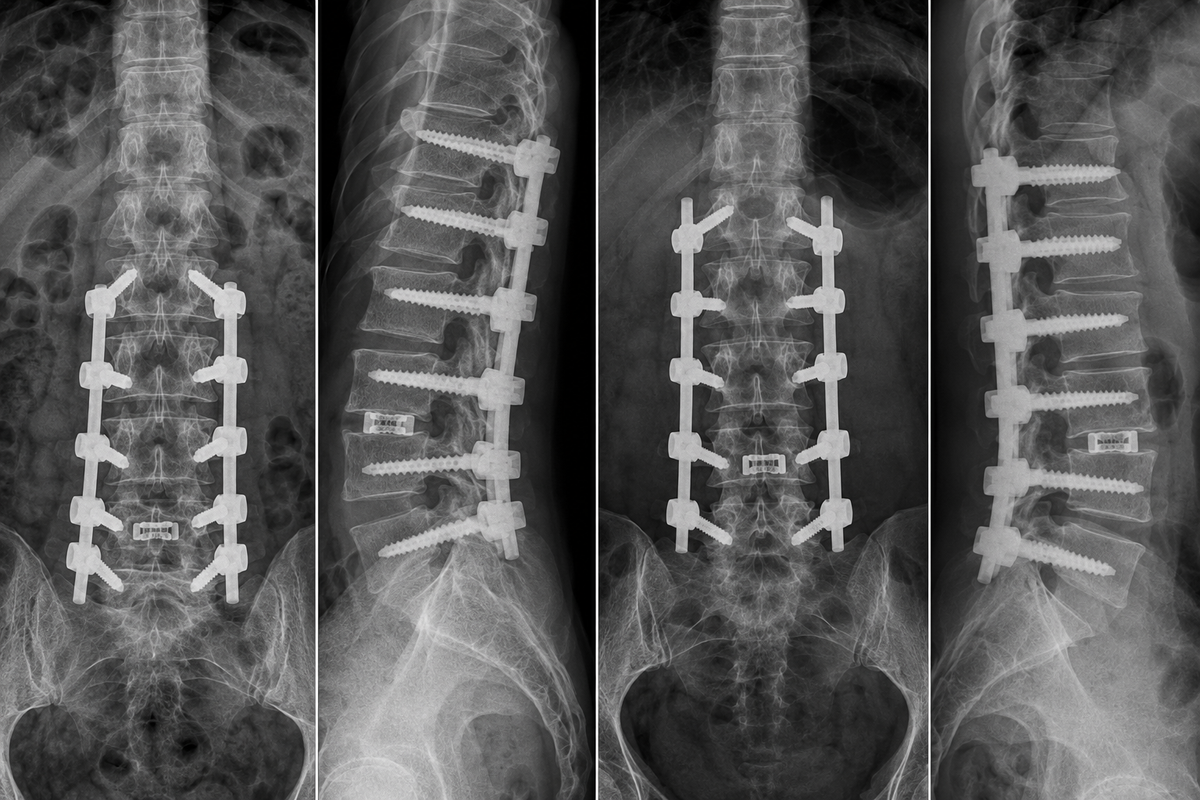
Revision Spine Surgery in Los Angeles
Orthopedic Spine Surgeon — Long Beach & Torrance, CA
Medically reviewed by Brandon A. Ortega, MD · Last updated July 31, 2026
Revision spine surgery addresses a new, persistent, or recurrent problem following a previous spinal operation. Depending on the underlying issue, treatment may involve renewed nerve decompression, extension or repair of a fusion, or removal and replacement of spinal hardware. Selected revisions may be performed using minimally invasive techniques, but complex cases may require an open approach. Recovery ranges from several weeks to several months, with longer healing when fusion is involved. Reduced nerve-related pain, improved function, restored stability, and satisfactory findings on follow-up imaging are common indicators of success.
What Is Revision Spine Surgery?
Revision spine surgery is a second operation performed after a previous cervical, thoracic, or lumbar procedure. It is not one specific technique. The operation is planned around the reason symptoms have continued, returned, or changed.
Revision surgery may be considered when testing identifies a correctable problem such as:
- Recurrent or remaining nerve compression
- Failure of a spinal fusion to heal
- Loose, broken, displaced, or painful hardware
- Infection around the surgical site or implants
- Progressive spinal deformity
- New instability
- Degeneration above or below a previous fusion
- Recurrent disc herniation
- Persistent spinal stenosis
- Fracture near a previously treated area
Pain after spine surgery does not automatically mean that the original operation failed or that another procedure is necessary. Symptoms may come from a new spinal condition, residual nerve damage, muscle weakness, arthritis, or another source that surgery may not correct. A thorough evaluation is therefore required before revision surgery is recommended.
Types of Revision Procedures We Offer
Revision Decompression
Revision decompression creates additional space around a spinal nerve or the spinal cord. It may be performed when compression remains after the original operation or develops later because of new bone growth, scar tissue, disc herniation, spinal stenosis, or changes at a nearby level.
Depending on the location of the compression, treatment may include a revision laminectomy, laminotomy, foraminotomy, or discectomy. Fusion may be added when decompression would create or worsen instability.
Fusion Extension or Repair
A previous fusion may require revision when the bones do not heal together, the spine becomes unstable, alignment deteriorates, or degeneration develops next to the fused segment.
The surgeon may repair the existing fusion, add bone-graft material, replace instrumentation, or extend the fusion to additional vertebrae. Correcting a deformity or a failed fusion may require a combined anterior, lateral, or posterior approach.
Hardware Removal or Replacement
Spinal screws, rods, plates, or cages may require removal or replacement if they become loose, break, move out of position, contribute to nerve compression, or are associated with infection.
Hardware is not routinely removed simply because it appears on imaging. The surgeon must determine whether it is causing symptoms and whether the spine will remain stable after removal. New or stronger fixation may be placed during the same operation when continued stabilization is required.
How We Determine the Need for Revision Surgery
The first step is identifying why symptoms have persisted or returned. The evaluation may include a detailed review of the original diagnosis, operative reports, implant information, previous imaging, recovery history, and the timing and location of current symptoms.
Diagnostic testing may include:
- Standing or motion X-rays to evaluate alignment and instability
- CT imaging to assess bone healing and hardware position
- MRI to evaluate discs, nerves, the spinal cord, infection, and surrounding soft tissue
- CT myelography when MRI findings are limited by metal implants
- Blood testing when infection is suspected
- Bone-density testing before a new or extended fusion
- Diagnostic injections when the source of pain remains uncertain
Revision surgery is generally considered only when the findings identify a structural or neurological problem that can reasonably be corrected. Nonsurgical care may remain appropriate when no surgically treatable cause is found.
General Patient Criteria
Potential candidates may have:
- Persistent, recurrent, or worsening symptoms after previous spine surgery
- New arm or leg pain, numbness, or weakness
- Progressive balance or walking difficulties
- Confirmed nerve or spinal-cord compression
- A failed fusion or unstable spinal segment
- Loose, broken, or displaced implants
- Progressive spinal deformity
- Symptoms and imaging findings that identify a correctable problem
- General health suitable for anesthesia and another operation
- Realistic expectations about revision surgery and recovery
Bone quality is especially important when additional fusion or instrumentation is planned. Poor bone density increases the risk of screw loosening, fracture, nonunion, and further revision. Diabetes, obesity, poor nutrition, nicotine use, infection, and multiple previous operations may also affect surgical risk and healing.
Revision surgery may not be recommended when the likely risks outweigh the expected benefit, symptoms cannot be connected to a treatable structural problem, or nonsurgical treatment remains a safer option.
What to Expect
Before Surgery
Revision surgery generally requires more detailed planning than an initial spinal operation. The surgeon must understand the altered anatomy, scar tissue, existing implants, previous fusion levels, and the reason the earlier treatment did not produce the intended result.
Preparation may include:
- Physical and neurological examination
- Updated X-rays, MRI, CT, or CT myelography
- Review of earlier operative reports
- Identification of existing hardware
- Blood tests and medical clearance
- Evaluation for infection
- Bone-density and nutritional assessment
- Medication and supplement review
- Nicotine cessation
- Arranging transportation and postoperative assistance
Patients should provide as much information as possible about previous procedures, including operative reports and implant records when available.
During Surgery
Revision spine surgery is generally performed under general anesthesia. The exact technique depends on the original procedure and the problem being corrected.
The surgeon may:
- Reopen a previous incision or use a different surgical approach.
- Carefully work through or around existing scar tissue.
- Identify and protect the spinal cord and nerve roots.
- Remove remaining or recurrent compressive tissue.
- Inspect the previous fusion and instrumentation.
- Remove or replace loose, damaged, or misplaced hardware.
- Add bone graft or extend the fusion when needed.
- Restore spinal alignment and stability.
- Confirm decompression and implant position before closing the incision.
Minimally invasive techniques may be used in selected cases to limit soft-tissue disruption. They are not appropriate when extensive hardware removal, multilevel reconstruction, severe deformity correction, or broad access to neural structures is required.
Recovery and Rehabilitation
Recovery depends on the type and extent of revision. A limited hardware removal or decompression may require less recovery than reconstruction of a failed multilevel fusion.
Patients are commonly encouraged to begin walking soon after surgery. Early recovery may include:
- Incision care
- Short, frequent walks
- Medication as directed
- Temporary limits on lifting, bending, and twisting
- Use of a brace when prescribed
- Follow-up neurological examinations
- X-rays or CT imaging to evaluate healing
- Physical therapy when medically appropriate
- Continued nicotine avoidance
Return to work may take several weeks or longer depending on the procedure and the physical demands of the patient’s occupation. When revision fusion is performed, the vertebrae commonly require several months to heal together. Rehabilitation may continue as strength, mobility, balance, and endurance improve.
Nerve pain may improve relatively quickly after successful decompression, but longstanding numbness or weakness can recover more slowly and may not resolve completely.
Potential Complications and Success Indicators
Revision spine surgery may be more technically complex than an initial operation because the anatomy has been altered and scar tissue or existing implants may be present. Research has found higher complication risks for revision procedures than for comparable primary spine surgery.
Potential complications include:
- Infection
- Bleeding or blood clots
- Poor wound healing
- Dural tear and spinal-fluid leakage
- Nerve-root or spinal-cord injury
- Persistent or worsening pain
- New numbness or weakness
- Failure of the revised fusion to heal
- Hardware loosening, movement, or breakage
- Loss of spinal alignment
- Recurrent stenosis or instability
- Need for another operation
Success should be measured against the specific reason for revision surgery. Indicators may include:
- Reduced arm or leg pain
- Improved strength, sensation, or walking ability
- Reduced spinal-cord or nerve compression
- Improved alignment and stability
- Stable instrumentation
- Progressive bone healing
- Better tolerance for work and daily activities
- No evidence of infection or neurological decline
Results are generally more predictable when testing identifies a specific correctable problem. HSS notes that revision decompression may be particularly helpful when leg symptoms are caused by clearly identified radiculopathy or spinal stenosis, while improvement in generalized back pain can be harder to predict.
Revision Spine Surgery in Los Angeles Q&A
Does persistent pain after spine surgery mean I need revision surgery?
No. Persistent pain may come from nerve damage, muscle weakness, arthritis, a new spinal condition, infection, hardware problems, or failure of the original fusion. Revision surgery is considered only when the evaluation identifies a problem that another operation can reasonably correct.
Can revision spine surgery be minimally invasive?
Sometimes. Smaller incisions and muscle-sparing techniques may be used for selected decompressions, hardware procedures, or fusion repairs. Extensive deformity correction, scar tissue, multilevel reconstruction, or major hardware replacement may require an open approach.
Is revision surgery more difficult than the original surgery?
Revision surgery is often more complex because the surgeon must account for scar tissue, altered anatomy, previous bone removal, existing implants, and reduced bone quality. The degree of difficulty depends on the original operation and the specific problem being corrected.
Why Choose BAO Spine?
Fellowship-trained expertise
Advanced, subspecialty training in complex and minimally invasive spine surgery.
Conservative care first
Most patients improve without surgery — treatment begins with the least invasive options.
Motion-preserving techniques
Cervical and lumbar disc replacement that protects your natural range of motion.
Two convenient locations
Personalized spine care in both Long Beach and Torrance, California.

About Dr. Ortega
Brandon A. Ortega, MD, is a fellowship-trained orthopedic spine surgeon providing comprehensive, personalized spinal care to adults in Long Beach and Torrance, California. His dedication to helping each patient regain mobility, reduce pain, and improve their quality of life has earned the respect of everyone in the community struggling with neck and back pain.
Consultation
Get expert care with revision spine surgery in Los Angeles
Request an appointment and Brandon A. Ortega, MD's team will reach out to schedule your visit — fellowship-trained, personalized spine care.
Prefer to call? Contact us.