
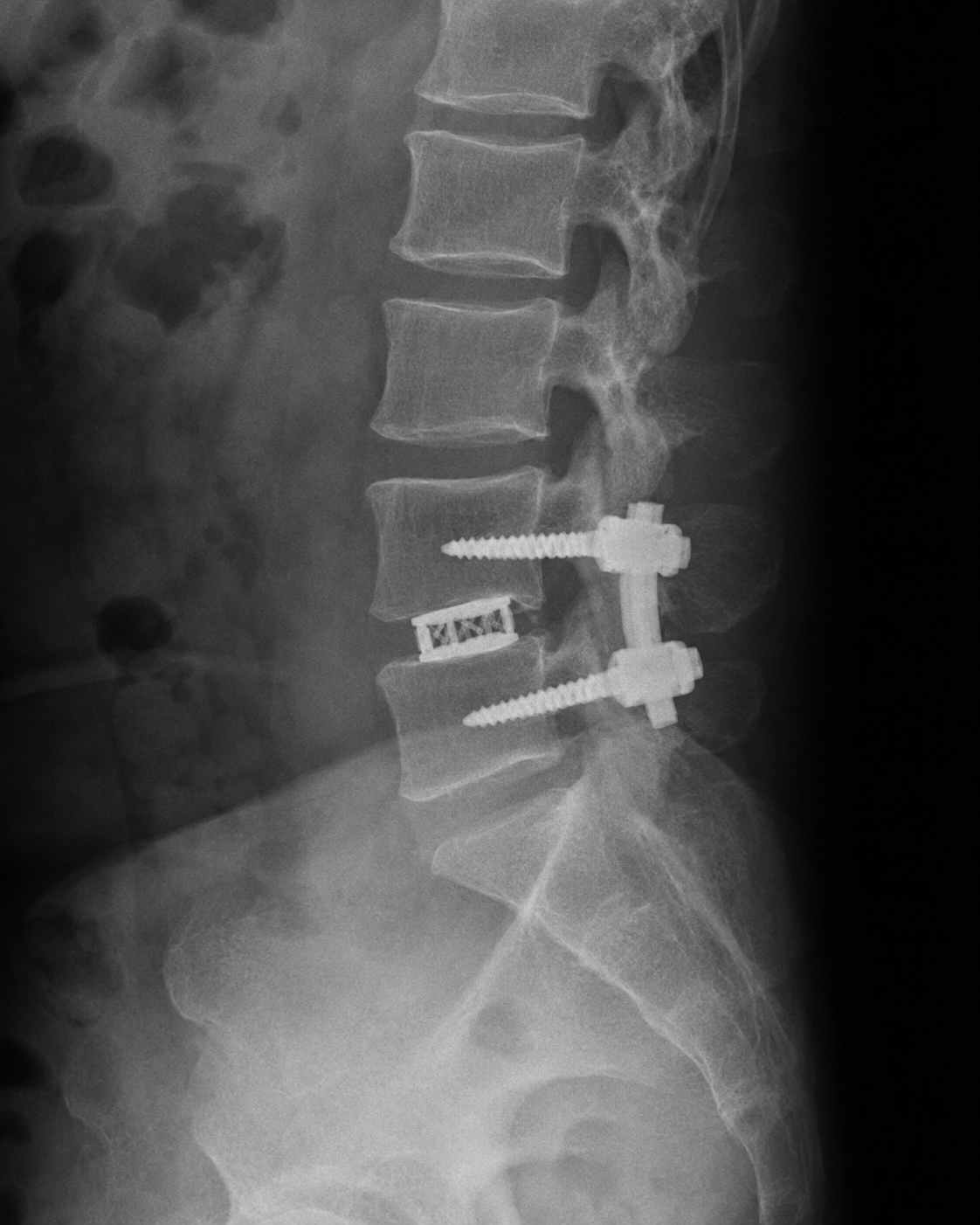
Transforaminal Lumbar Interbody Fusion (TLIF) Surgery in Los Angeles
Orthopedic Spine Surgeon — Long Beach & Torrance, CA
Medically reviewed by Brandon A. Ortega, MD · Last updated July 31, 2026
Transforaminal lumbar interbody fusion stabilizes the lower spine by removing a damaged disc and placing a bone-filled spacer between adjacent vertebrae. TLIF may be performed through an open or minimally invasive approach; minimally invasive TLIF uses smaller incisions and less muscle dissection. Functional recovery commonly takes about 6 to 12 weeks, although complete fusion may take up to a year. Reduced back or leg pain, improved mobility, stable implants, and progressive bone growth on imaging are common indicators of success.
What Is a Transforaminal Lumbar Interbody Fusion?
Transforaminal lumbar interbody fusion, abbreviated TLIF, is a spinal fusion procedure performed through the back of the lumbar spine.
The surgeon approaches the damaged disc from one side through the opening where a spinal nerve exits. Part of the disc is removed and replaced with a cage or spacer containing bone-graft material. Screws and rods are then commonly placed to stabilize the vertebrae while new bone develops across the treated level.
The procedure can also create more space around compressed nerves and restore height to a collapsed disc space. Unlike PLIF, which approaches the disc more centrally, TLIF uses a one-sided pathway that generally requires less movement of the nerve roots.
Minimally invasive TLIF uses smaller incisions, muscle dilation, specialized retractors, and image-guided instrumentation. This approach may reduce muscle damage, postoperative discomfort, and recovery time in appropriately selected patients.
Conditions Treated
TLIF may be considered for lumbar conditions involving disc degeneration, instability, deformity, or nerve compression, including:
- Degenerative disc disease
- Spondylolisthesis
- Disc-space collapse
- Lumbar spinal stenosis with instability
- Recurrent disc herniation
- Lumbar radiculopathy or sciatica
- Degenerative scoliosis
- Failed previous lumbar fusion
- Persistent instability following decompression surgery
The procedure is generally most appropriate when the patient’s symptoms, physical examination, and imaging identify a specific unstable or damaged spinal level. Spinal fusion is not expected to relieve every form of generalized lower-back pain.
Surgery Candidates and General Patient Criteria
TLIF is commonly considered after appropriate nonsurgical treatment has not provided adequate relief. Conservative care may include physical therapy, medication, activity modification, or spinal injections.
Potential candidates may have:
- Persistent lower-back or leg pain
- Numbness or weakness caused by nerve compression
- Confirmed vertebral instability or slippage
- Significant disc degeneration or collapse
- Symptoms that correspond with the affected lumbar level
- Adequate bone quality to support the cage and screws
- General health suitable for anesthesia and surgery
- The ability to follow postoperative restrictions
Bone quality, diabetes, nutrition, body weight, previous spinal surgery, and the number of levels being fused may affect healing. Nicotine use is especially concerning because it can impair wound healing and increase the risk that the vertebrae will not form a solid fusion.
What to Expect
Before Surgery
Before TLIF, the surgical team reviews the patient’s symptoms, medical history, medications, previous treatments, and diagnostic imaging.
Preparation may include:
- Physical and neurological examination
- Lumbar X-rays, MRI, or CT imaging
- Blood tests and medical clearance
- Bone-density assessment when indicated
- Medication and supplement review
- Instructions concerning blood-thinning medication
- Nicotine cessation
- Fasting before anesthesia
- Arranging transportation and assistance at home
Patients should not stop prescribed medications unless instructed by their treating medical team.
During Surgery
TLIF is usually performed under general anesthesia with the patient positioned face down.
The surgeon generally:
- Makes an incision in the lower back.
- Reaches the affected level from one side of the spine.
- Removes part of a facet joint to access the disc.
- Removes damaged disc material and decompresses the affected nerve.
- Places a cage containing bone graft into the disc space.
- Inserts screws and rods to stabilize the vertebrae.
- Confirms alignment and implant placement before closing the incision.
In a minimally invasive TLIF, the surgeon accesses the spine through smaller incisions using muscle dilators and specialized instruments.
Recovery and Rehabilitation
Patients commonly begin walking on the day of surgery. Functional recovery often occurs over approximately 6 to 12 weeks, but timing varies according to the number of levels treated, surgical approach, occupation, health, and neurological symptoms. Complete bone fusion may take up to one year.
Recovery instructions may include:
- Taking short, frequent walks
- Keeping the incision clean and dry
- Avoiding heavy lifting, bending, and twisting
- Taking medication as directed
- Wearing a lumbar brace when prescribed
- Remaining nicotine-free
- Attending follow-up examinations and imaging
- Beginning physical therapy when approved
Physical therapy may help restore walking tolerance, strength, posture, flexibility, and safe movement mechanics. Patients may feel better before the fusion is fully developed, so activity should be increased according to the surgeon’s guidance rather than symptoms alone.
Potential Complications and Success Indicators
Potential complications of TLIF include:
- Infection
- Bleeding or blood clots
- Reaction to anesthesia
- Nerve injury
- Dural tear and spinal-fluid leakage
- New or worsening numbness or weakness
- Implant movement or settling
- Hardware loosening or breakage
- Failure of the vertebrae to fuse
- Persistent or recurrent pain
- Degeneration at nearby spinal levels
- Need for revision surgery
The risk of nonunion may be higher in patients who use nicotine or have diabetes. Fusion also permanently reduces movement at the treated spinal level and may place additional mechanical stress on nearby levels over time.
Indicators of a successful outcome may include:
- Reduced lower-back or leg pain
- Improved standing and walking tolerance
- Improved strength or sensation
- Greater spinal stability
- Stable cages, screws, and rods
- Progressive bone growth across the treated level
- Improved ability to work and perform daily activities
HSS reports that 85% to 90% of its studied TLIF patients experienced meaningful improvement and were satisfied with their outcomes, although individual results vary according to diagnosis, health, bone quality, and surgical complexity.
Transforaminal Lumbar Interbody Fusion (TLIF) Surgery in Los Angeles Q&A
Is TLIF considered minimally invasive?
TLIF can be performed through either an open or minimally invasive approach. Minimally invasive TLIF uses smaller incisions and less muscle dissection, but it remains major spinal fusion surgery involving disc removal, bone graft, a cage, screws, and rods.
What is the difference between TLIF and PLIF?
Both procedures access the lumbar disc through the back. PLIF approaches the disc closer to the center of the spine, while TLIF approaches from one side through the neural foramen. The TLIF pathway generally requires less nerve-root retraction.
How long does TLIF take to heal?
Many patients complete their main functional recovery within 6 to 12 weeks, but the bone graft may require several months—and sometimes up to a year—to form a mature fusion.
Why Choose BAO Spine?
Fellowship-trained expertise
Advanced, subspecialty training in complex and minimally invasive spine surgery.
Conservative care first
Most patients improve without surgery — treatment begins with the least invasive options.
Motion-preserving techniques
Cervical and lumbar disc replacement that protects your natural range of motion.
Two convenient locations
Personalized spine care in both Long Beach and Torrance, California.

About Dr. Ortega
Brandon A. Ortega, MD, is a fellowship-trained orthopedic spine surgeon providing comprehensive, personalized spinal care to adults in Long Beach and Torrance, California. His dedication to helping each patient regain mobility, reduce pain, and improve their quality of life has earned the respect of everyone in the community struggling with neck and back pain.
Consultation
Get expert care with transforaminal lumbar interbody fusion (TLIF) surgery in Los Angeles
Request an appointment and Brandon A. Ortega, MD's team will reach out to schedule your visit — fellowship-trained, personalized spine care.
Prefer to call? Contact us.